


Introduction
In 2026, millions of Indians are asking Google questions out loud instead of typing them. A vegetable vendor in Jaipur asks, “aaj tamatar ka bhav kya hai?” A college student in Bengaluru says, “show me the best budget laptops under 40000.” A parent in Lucknow asks, “near me sabse achha pediatrician kaun hai?” Voice search has moved from novelty to habit across India, and websites that ignore it are quietly losing traffic to competitors that have adapted.
India’s voice search boom is powered by affordable smartphones, cheap data from carriers like Jio, and assistants that understand Hindi, Hinglish, and regional languages. A large share of new Indian internet users are more comfortable speaking than typing in English, which makes voice the default entry point to the web for them.
For website owners, this shift changes the rules of SEO. This guide walks you through voice search optimisation for Indian websites in 2026: how voice search works, how Indian users actually speak to their devices, and the exact steps to win the single spoken answer.

1. How Voice Search Works in India in 2026
Voice search follows a simple chain: the user speaks, the assistant transcribes, Google interprets the intent, and then reads out the best single answer, usually from a featured snippet or local result. Every link in this chain has India-specific twists.
First, transcription now handles code-switching. Most Indians speak Hinglish to their phones, not pure Hindi or English: “Google, best AC under 30000 kaunsa hai?” Speech recognition is trained on this mixed speech but still trips on uncommon brand names and local place names, so spell things the way people say them, not just the way a textbook would.
Second, intent interpretation leans on conversational context. A typed query might be “plumber Mumbai,” but spoken aloud it becomes “Google, mujhe Mumbai mein ek achha plumber chahiye jo abhi aa sake.” The assistant extracts the service, the city, and the urgency from a full sentence, so websites that answer full-sentence questions directly are the ones that get picked.
Third, the answer almost always comes from one source. On a screen, ranking fifth still gets clicks. In voice, there is usually only one spoken answer, drawn from featured snippets, People Also Ask boxes, and local business results. Winning voice search in India is therefore largely about winning position zero and local results.
2. How Indians Actually Use Voice Search: Key Patterns
These patterns should shape every optimisation decision below.
- Question-first phrasing. Voice queries overwhelmingly begin with who, what, where, when, why, how, or their Hindi equivalents like kaun, kya, kab, kyun, and kaise. Content that leads with a clear question and then answers it matches this pattern naturally.
- Local intent dominates. A huge share of voice searches are “near me” queries: restaurants, clinics, ATMs, petrol pumps, coaching centres. Google Assistant in India is effectively a local discovery tool for millions of users.
- Language mixing is the norm. Queries blend English nouns with Hindi grammar. Your keyword research should include Hinglish variants like “best mobile under 15000 kaunsa hai” alongside formal English versions.
- Long-tail by default. Spoken queries average significantly more words than typed ones. Optimising for long-tail, natural-language phrases is not optional for voice; it is the whole game.
- Action-oriented. Voice users want to do something: call, navigate, book, buy. Pages that end with a clear next step perform better with this audience.
3. Target Conversational, Long-Tail Keywords
Traditional keyword research targets short phrases like “voice SEO.” Voice search optimisation in India requires thinking in full sentences. Start by listing the questions your customers actually ask, in the words they use.
Useful sources: Google’s People Also Ask boxes, Quora India, YouTube comments on Hindi tech channels, and your own support chats or call logs.
Structure your pages around these questions. A practical method: create FAQ-style sections where each H3 is a literal question (“How much does a website cost in India?”) followed by a concise answer of 40 to 60 words, which matches the typical length of a spoken answer Google reads aloud.
Also build dedicated question pages for your most valuable queries.
4. Win Featured Snippets: The Voice Answer Engine
In 2026, the majority of Google Assistant answers in India are still drawn from featured snippets, the boxed answers at the top of search results. If you want the voice traffic, you must compete for position zero.
Featured snippets reward content that answers a question directly, quickly, and in a format Google can read aloud. Follow these rules:
- Answer first, then elaborate. Put the direct answer in the first 40 to 60 words after the question heading. Then expand with detail below for readers who want more.
- Use the formats Google prefers. Paragraph snippets for definitions and explanations, numbered lists for processes and steps, bullet lists for features and examples, and tables for comparisons and prices. Match the format to the question type.
- Use clear heading hierarchy. One H1 per page, H2s for sections, and H3s for individual questions. This structure helps Google extract exactly the right block of text for the spoken answer.
- Keep answers self-contained. The snippet must make sense when read aloud with no surrounding context. Avoid answers that begin with “As mentioned above” or “It depends” without immediately saying what it depends on.
Our Google Search Console tips for finding hidden opportunities show exactly how to surface these chances.
5. Optimise for Hindi and Regional Language Queries
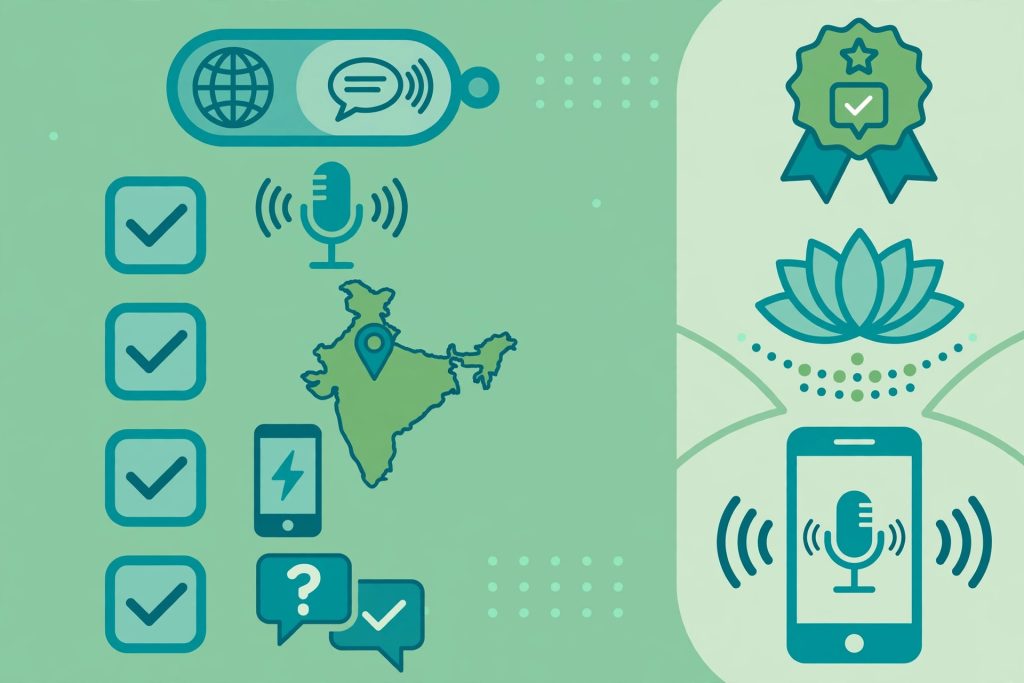
This is the step most Indian websites skip, and it is where the biggest voice search opportunity lies in 2026. A large and growing share of Indian voice queries are spoken in Hindi, Hinglish, or regional languages like Tamil, Telugu, Bengali, and Marathi.
You do not need to translate your entire site, but you should:
- Include Hinglish phrasing naturally. Where it fits, use the mixed language your audience speaks. A sentence like “Here are the best smartphones under 20000, jo aap 2026 mein kharid sakte hain” may feel informal, but it mirrors real queries and can match voice transcriptions more closely.
- Add an FAQ in Hindi for key pages. Even a short Hindi FAQ section on your most important service pages can capture voice queries that English-only competitors miss entirely.
- Use schema-friendly transliteration. If you mention place names or local terms, include common Roman-script spellings people actually speak, such as “Connaught Place” alongside “CP” or “Rajaji Salai” alongside its colloquial name.
- Consider full regional language pages for high-value topics. Competition for regional language queries is still thin, so dedicated Tamil or Marathi landing pages can dominate voice results in those regions.
Voice assistants transcribe what they hear. If users say “sasta aur achha” and your page only says “affordable and good,” you are relying on Google to bridge the gap. Often, the page that uses the user’s own words wins.
6. Local Voice SEO: Winning “Near Me” Searches
“Near me” voice searches are the commercial heart of voice SEO in India. When someone asks, “OK Google, sabse paas ka ATM kahan hai?” the answer comes from local business data, not a blog post. To be the answer, your local presence must be flawless.
- Claim and complete your Google Business Profile. Fill every field: exact address, phone number, hours, services, photos. An incomplete profile loses to a complete one almost every time.
- Keep NAP consistent everywhere. Your Name, Address, and Phone number must match exactly across your website, Google, Justdial, Sulekha, and every directory. Inconsistencies confuse the assistant and cost you the answer.
- Collect reviews in volume. Voice assistants favour highly rated, well-reviewed businesses. Ask happy customers for Google reviews and respond to every review you receive.
- Add local FAQ content to your site. Answer the spoken questions locals ask: “Do you offer home delivery in Andheri?” “What are your Sunday hours?” “Is parking available?” Each of these is a voice query waiting for an answer.
- Use LocalBusiness schema markup. Structured data helps Google confidently pull your hours, address, and services into a spoken answer.
Read our complete guide on local SEO for Indian small businesses to rank higher on Google Maps for the full playbook.
7. Technical Foundations: Speed, Mobile, and Schema
Voice search is overwhelmingly mobile, often on mid-range phones with variable network speeds, so technical performance is a prerequisite for voice SEO, not a separate concern.
- Mobile-first is mandatory. The majority of Indian voice searches happen on smartphones. Your site must be fully responsive, with tap targets and fonts that work on small screens.
- Speed wins the answer. Google will not read out an answer from a slow page. Compress images, enable caching, and aim for Core Web Vitals in the green, especially Largest Contentful Paint.
- Implement Speakable schema. The SpeakableSpecification schema marks the sections of your page most suitable for text-to-speech. It is a direct signal to assistants about which content to read aloud.
- Use FAQ and HowTo schema. FAQPage markup makes your question-and-answer sections eligible for rich results, and HowTo markup suits step-by-step voice queries like “how to apply for a PAN card online.”
- Secure with HTTPS. Voice assistants strongly prefer secure pages for spoken answers. If your site still runs on HTTP in 2026, fix that before anything else.
Many voice SEO failures are really technical SEO failures in disguise. Run a full check with our guide to technical SEO issues that hold back website rankings before assuming your content is the problem.
8. Measure Your Voice Search Performance
Voice search has no dedicated report in Search Console, but you can triangulate it:
- Filter Search Console queries by question words. Look at queries containing who, what, where, when, why, how, kaise, kya, kab, and kahan. Rising impressions on these indicate growing voice-style traffic.
- Track long-tail query growth. An increase in queries of five or more words, especially conversational ones, is a strong proxy for voice.
- Monitor featured snippet ownership. Use a rank tracker that reports snippet ownership for your target questions. Every snippet you hold is a potential spoken answer.
- Watch mobile vs desktop splits. Voice traffic is almost entirely mobile. If mobile impressions climb while desktop stays flat, voice may be part of the story.
- Ask customers. The simplest method: ask new callers or walk-ins how they found you. “I asked Google” is a voice attribution you will never see in analytics.
Frequently Asked Questions
What is voice search optimisation?
Voice search optimisation shapes your website’s content, structure, and technical setup so that voice assistants like Google Assistant select your site as the single spoken answer to a user’s question. It focuses on conversational keywords, direct answers, featured snippets, local SEO, and mobile performance.
Is voice search really important for Indian websites in 2026?
Yes. India is one of the world’s largest voice search markets thanks to affordable smartphones, cheap data, and assistants that understand Hindi, Hinglish, and regional languages. For local businesses especially, voice queries like “near me” searches drive real calls, visits, and sales every day.
How do Hindi and Hinglish queries affect my SEO strategy?
They expand it. Many Indians search by speaking in Hindi or Hinglish, so pages with natural mixed-language phrasing and Hindi FAQ sections can capture voice traffic that English-only pages miss. Competition for regional language queries is still low, making this a high-opportunity tactic in 2026.
How long does it take to see results from voice search optimisation?
Most sites see movement in 4 to 12 weeks. Featured snippet wins can happen faster if your pages already rank on page one, while local voice visibility improves as your Google Business Profile gains reviews and completeness. Technical fixes like speed improvements can show effects within weeks.
Do I need separate pages for voice search?
Usually not. Optimise your existing pages: add question-based headings, put direct 40 to 60 word answers right after them, add FAQ sections, and apply the right schema markup. Create dedicated pages only for high-value questions that deserve a full answer of their own.
Can small businesses compete in voice search against big brands?
Absolutely, especially locally. Voice assistants answering “near me” queries prioritise proximity, ratings, and profile completeness over brand size. A well-optimised local shop in Pune can beat a national chain as the spoken answer for nearby searchers.
Conclusion
Voice search optimisation for Indian websites in 2026 comes down to a simple principle: write and structure your site the way your customers actually speak. Target conversational, long-tail questions instead of stiff keywords. Answer directly in 40 to 60 words so Google can read your words aloud. Chase featured snippets and local results, because that is where spoken answers come from. Speak your audience’s language, literally, with Hinglish and Hindi where it fits. And keep your site fast, mobile-friendly, and marked up with schema so assistants can trust and parse it.
Start with your highest-traffic pages, add question headings and direct answers, complete your Google Business Profile, and measure the question queries in Search Console. Do that consistently, and the next time someone in India asks their phone a question in your niche, the voice they hear could be reading your words.

1 Comment
Pingback: How to Get Cited in Google AI Overviews: An SEO Guide for Indian Websites (2026)