

Introduction
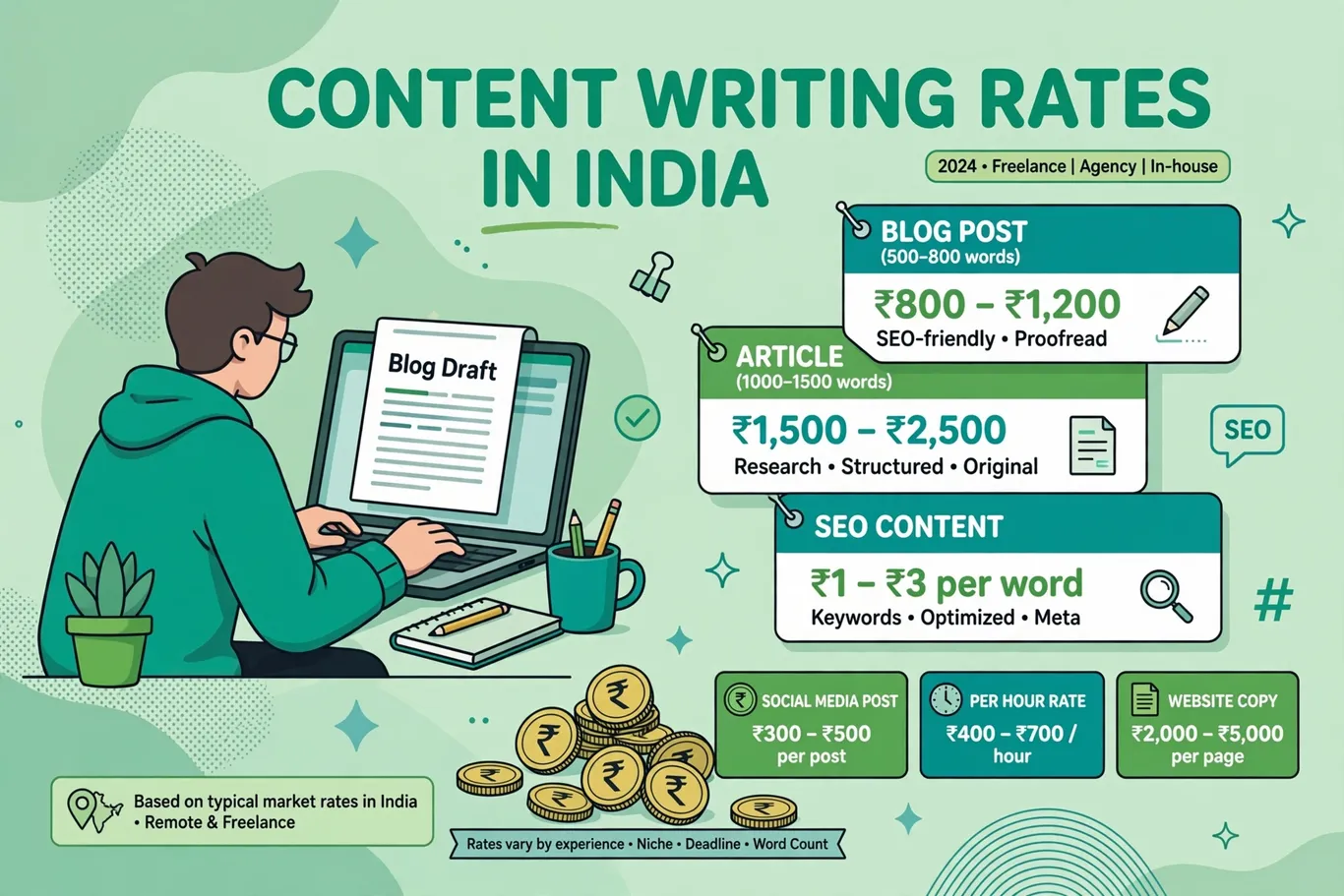
How much should you pay a content writer in India in 2026? Rates range from about Rs 1 per word for basic bulk writing to Rs 8 or more per word for specialist work. That gap is the difference between content that merely fills a page and content that ranks on Google, earns trust, and brings in customers. This guide gives you the full picture, with rupee prices throughout: a consolidated rate table, retainers, rates by niche and city, and advice on judging quality, hiring safely, and how AI has changed the market.
Content Writing Rates in India 2026: The Complete Rate Table
| Service | Typical range in 2026 |
|---|---|
| Freelancer, general, per word | Rs 1 to Rs 3 |
| Freelancer, experienced, per word | Rs 3 to Rs 5 |
| Freelancer, specialist, per word | Rs 5 to Rs 8 |
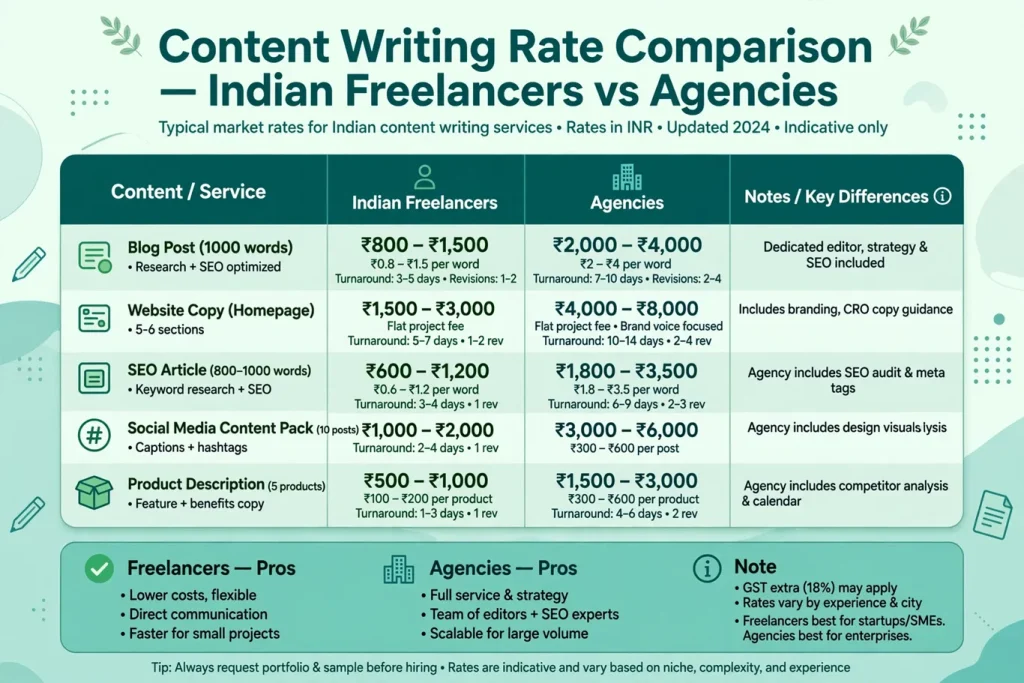
| Freelancer, per article, 1,000 words | Rs 1,500 to Rs 6,000 |
| Freelancer, per article, 2,000 words | Rs 3,000 to Rs 12,000 |
| Agency, per word | Rs 3 to Rs 10 |
| Agency, per article, 1,500 words | Rs 5,000 to Rs 15,000 |
| Monthly retainer, freelancer | Rs 15,000 to Rs 60,000 |
| Monthly retainer, agency | Rs 30,000 to Rs 1,50,000 |
| Website copy, per page | Rs 2,000 to Rs 10,000 |
| Social media captions, per post | Rs 200 to Rs 1,500 |
Per-Word vs Per-Article vs Hourly vs Retainer
Per-word pricing is the most common model in India. It is simple to compare, but it rewards length, not quality, since a loose 1,500-word article pays nearly twice as much as a tight 800-word one. Agree on a target word count range and a clear brief before work starts.
Per-article pricing fixes the cost upfront. A 1,500-word SEO blog might cost Rs 4,000, whether the writer takes three hours or six. The catch is scope creep, so define length, revision count, and research expectations in advance.
Hourly pricing appears in consulting, editing, and strategy work, typically at Rs 500 to Rs 3,000 per hour. The catch is transparency, since you cannot easily see how the hours were spent. Use it for audits and strategy, not bulk articles.
Monthly retainers offer the best value for regular publishing: a fixed fee for an agreed volume, such as 12 blogs a month. The catch is commitment, so negotiate rollover terms and a clear deliverable list. Compare these figures with current SEO pricing in India , since content and SEO budgets usually sit side by side.
Freelancer Rates and Agency Rates in India
Beginner freelancers charge Rs 0.50 to Rs 1.50 per word. They can handle simple rewrites and product descriptions, but they need detailed briefs and close editing. Mid-level freelancers with two to five years of experience charge Rs 2 to Rs 4 per word, the sweet spot for most small businesses. A 1,500-word blog from a mid-level writer typically costs Rs 3,000 to Rs 6,000. Experienced freelancers charge Rs 4 to Rs 8 per word, and top specialists charge more. If you are considering this career, read our guide on how to start freelance content writing in India in 2026.
Agencies charge more because the price covers a writer, an editor, keyword research, plagiarism checks, and a project manager. Small agencies charge Rs 3 to Rs 6 per word, mid-sized agencies Rs 5 to Rs 8 per word, and premium agencies Rs 8 to Rs 12 per word, with retainers from Rs 60,000 a month. Agencies suit businesses needing volume, consistency, and reliability. Ask who will write and edit your content, how many revisions are included, and whether SEO is part of the price.
Rates by Niche
- SaaS and B2B technology: Rs 4 to Rs 8 per word. Writers must understand software and write for decision makers.
- Fintech: Rs 5 to Rs 9 per word. Accuracy is critical, because wrong figures about loans, investments, or tax can cause real harm.
- Health and medical: Rs 4 to Rs 8 per word for general wellness, and Rs 6 to Rs 10 per word where medical accuracy is needed.
- Legal: Rs 5 to Rs 10 per word. It demands precision and current knowledge of Indian law.
- E-commerce and product writing: Rs 1 to Rs 3 per word, since the format is short and repeatable.
- Real estate, education, and travel: generally Rs 2 to Rs 5 per word, with higher rates for in-depth guides.
Rates by City: Metros vs Tier-2 Cities
In Bengaluru, experienced freelancers commonly charge Rs 3 to Rs 7 per word, with specialists reaching Rs 8 or more, driven by startup and SaaS demand. In Mumbai, freelancers charge similar rates, while agencies serving corporate clients often start at Rs 8,000 per article. In Delhi and the National Capital Region, rates typically run from Rs 2.50 to Rs 6 per word.
In Tier-2 cities such as Jaipur, Indore, Lucknow, Nagpur, Coimbatore, and Kochi, rates are usually 20 to 40 percent lower, with good mid-level writers charging Rs 1.50 to Rs 3.50 per word.
What Affects the Price
Research depth comes first: an article based on five sources and interviews takes far longer than one based on general knowledge. Expertise is second: a writer who already knows your industry writes faster and more accurately. Turnaround is third: standard delivery is three to five working days, while 24-hour delivery often carries a 25 to 50 percent rush fee. Revision count, SEO optimisation, image sourcing, linking, and publishing also add cost, so clarify the full scope before agreeing a price.
How to Judge Quality at Each Price Band
- Below Rs 2 per word, look for clear language and correct grammar. Red flags include copied phrases, factual errors, and keyword stuffing.
- At Rs 2 to Rs 5 per word, expect research, good subheadings, and close adherence to your brief. Red flags include generic introductions and thin coverage.
- Above Rs 5 per word, expect expertise: accurate detail, credible sources, and a confident voice. Red flags include vague claims without evidence and outdated information.
Always run a paid test before a large order. A 500 to 800-word test on a real topic, at the writer’s normal rate, tells you more than ten portfolio links. Confirm the revision policy in writing: how many revisions are included and what counts as a revision versus new work.
Hiring Checklist: Finding Writers, Tests, Contracts, and GST
- Where to find writers: referrals, LinkedIn, and platforms such as Upwork and Fiverr. Shortlist three to five writers and compare samples.
- Test assignments: give every shortlisted writer the same brief, word count, and deadline, and pay for the test.
- Contracts: use a written agreement stating scope, rate, payment schedule, delivery dates, revision policy, ownership, and confidentiality.
- Payment terms: 50 percent advance and 50 percent on delivery for new writers, or full payment within 7 to 15 days for trusted writers.
- GST on invoices: GST-registered writers and agencies usually charge 18 percent GST and should provide an invoice with their GSTIN. Clarify GST before agreeing a price, so a Rs 5,000 quote does not become Rs 5,900 at invoice time.
- Communication: agree on one channel, share a brand guide, and use a clear brief every time.

How AI-Assisted Writing Is Affecting Rates in 2026
AI has made basic, formulaic content cheaper. Short product descriptions, simple listicles, and first drafts of general blogs can now be produced faster, and some AI-assisted drafts cost Rs 0.50 to Rs 1 per word. What still commands a premium is original thinking, expertise, and trust. AI cannot interview a customer, test a product, or bring ten years of industry experience to an article. Expert-led content, original research, and case studies still pay Rs 5 to Rs 8 per word or more.
Be clear about what you are buying. If a writer uses AI for research or a first draft, then adds real editing, fact checking, and original insight, that is a legitimate workflow. If a writer delivers raw AI output with light editing, you are overpaying above budget rates. Ask writers how they use AI and how they check facts. Search engines do not penalise AI-assisted content automatically, but they do penalise thin, unhelpful, and inaccurate content. Our guide to SEO content writing for Indian websites in 2026 explains how to keep quality high while using modern tools well.
Common Pricing Mistakes to Avoid
Do not choose the cheapest writer for a high-stakes page. A homepage or landing page that brings in leads deserves your best writer. Do not pay per word without a word count range, or costs rise. Do not skip the brief: a vague instruction invites a generic article and extra revisions. Do not ignore editing, since even good writers need an editor. A strong article can bring traffic and leads for years, so judge a Rs 6,000 article against a Rs 3,000 one by which is more likely to rank and convert over twelve months.
FAQ
How much does content writing cost in India in 2026?
General freelance writing costs Rs 1 to Rs 3 per word, experienced freelancers charge Rs 3 to Rs 5 per word, and specialists charge Rs 5 to Rs 8 per word. Agencies usually charge Rs 3 to Rs 10 per word.
What is a good per-word rate for a beginner content writer in India?
A beginner typically charges Rs 0.50 to Rs 1.50 per word in 2026. Beginners can handle simple descriptions and short blogs, but they need detailed briefs and close editing.
How much should I pay for a 1,000-word article in India?
A 1,000-word article costs roughly Rs 1,500 to Rs 3,000 from a general freelancer, Rs 3,000 to Rs 5,000 from an experienced freelancer, and Rs 4,000 to Rs 8,000 from an agency.
Are agency rates worth it compared to freelancers?
Agency rates are worth it when you need volume, consistency, editing, SEO, and reliable delivery. Freelancers offer better value for a small number of articles or a tight budget.
How much does a monthly content writing retainer cost in India?
A monthly retainer typically costs Rs 15,000 to Rs 60,000 per month for a freelancer and Rs 30,000 to Rs 1,50,000 per month for an agency in 2026.
Does AI reduce content writing rates in India?
AI has reduced rates for basic, formulaic content, with some drafts now available for Rs 0.50 to Rs 1 per word. It has not reduced rates for expert content, which still commands Rs 5 to Rs 8 per word or more.
Should I pay per word or per article?
Pay per word when the scope is clear and you want easy comparison, and pay per article when you want a fixed cost. For regular publishing, a monthly retainer usually gives the best value.
Do content writers in India charge GST?
GST-registered writers and agencies usually charge 18 percent GST and should provide an invoice with their GSTIN. Freelancers below the threshold may not charge GST, but should still provide a clear invoice.
Conclusion
General freelance writing starts around Rs 1 per word, experienced writers charge Rs 3 to Rs 5 per word, and specialists earn Rs 5 to Rs 8 per word or more. Agencies charge a premium for managed delivery, editing, and SEO, while retainers offer the best value for regular publishing. Match the price to the job, judge writers on samples and paid tests, agree on scope, revisions, and GST upfront, and use a clear brief every time. AI has made basic content cheaper, but it has made genuine expertise more valuable, not less.
