

Introduction
India now has one of the largest and most competitive software markets in the world. Thousands of SaaS companies, from Bengaluru and Hyderabad to Pune and Gurugram, compete for the same buyers. Paid ads have become expensive: one click for a keyword such as CRM software can cost Rs. 80 to Rs. 300 or more. That is why SaaS SEO in India has become a core growth channel in 2026.
SEO for SaaS differs from SEO for a blog or shop. A SaaS buyer does not decide in one visit: they compare products, read documentation, check pricing, watch a demo, ask their team, and only then start a free trial. This guide is written for small and mid-sized Indian SaaS teams, covering keyword research, technical fixes, content that converts, costs in rupees, common mistakes, and measuring success by trials rather than traffic. If you are just getting started, our guide on SEO for startups in India explains how a new company should set up its first SEO foundations.
Why SaaS SEO Differs from Regular SEO
Most SEO advice is written for blogs or online shops, and SaaS is different. First, the buying cycle is longer: a buyer may take weeks or months, moving from problem to solutions to comparisons to pricing and finally to a trial, so content must serve every stage. Second, one customer is worth a lot. A B2B SaaS customer in India may pay Rs. 12,000 a year, or Rs. 1,20,000 on a team plan, so ten high-intent rankings can matter more than a thousand low-intent ones. Third, SaaS sites are technically complex, with app subdomains, login pages, pricing calculators, documentation portals and changelogs that confuse search engines unless organised carefully. Fourth, trust matters more, because a buyer trusts your product with their data and their team’s time. Reviews, case studies, security pages and clear pricing all build that trust. Finally, SaaS SEO in 2026 must work for AI search too, since more Indian buyers ask ChatGPT, Google AI Overviews and Perplexity for recommendations before clicking a link.
A Step-by-Step SaaS SEO Starter Plan for Small Indian SaaS Teams
Large SaaS companies can afford five SEOs and a content budget of several lakhs per month. Most Indian SaaS teams cannot, and that is fine: a small team can win by being focused and consistent. Here is a practical 90-day plan.
In weeks 1 to 2, fix the foundations: check that your site loads in under three seconds on mobile data and can be crawled by Google, set up Search Console and Analytics 4, and submit your sitemap. Keep the marketing site on the main domain and the app on a subdomain such as app.yourdomain.com.
In weeks 3 to 4, research Indian-market keywords, map each one to a single page, and identify gaps. One strong page beats three thin pages.
In weeks 5 to 8, fix the highest-priority technical problems, improve product, pricing and feature pages, and publish your first comparison and use-case pages, which are closest to revenue.
In weeks 9 to 12, publish two to four high-quality articles, build a few backlinks through partnerships, and update your best pages rather than only writing new ones. The golden rule is focus: pick one product line, one audience and ten to twenty keywords, win those first, then expand.
India Keyword Research Walkthrough
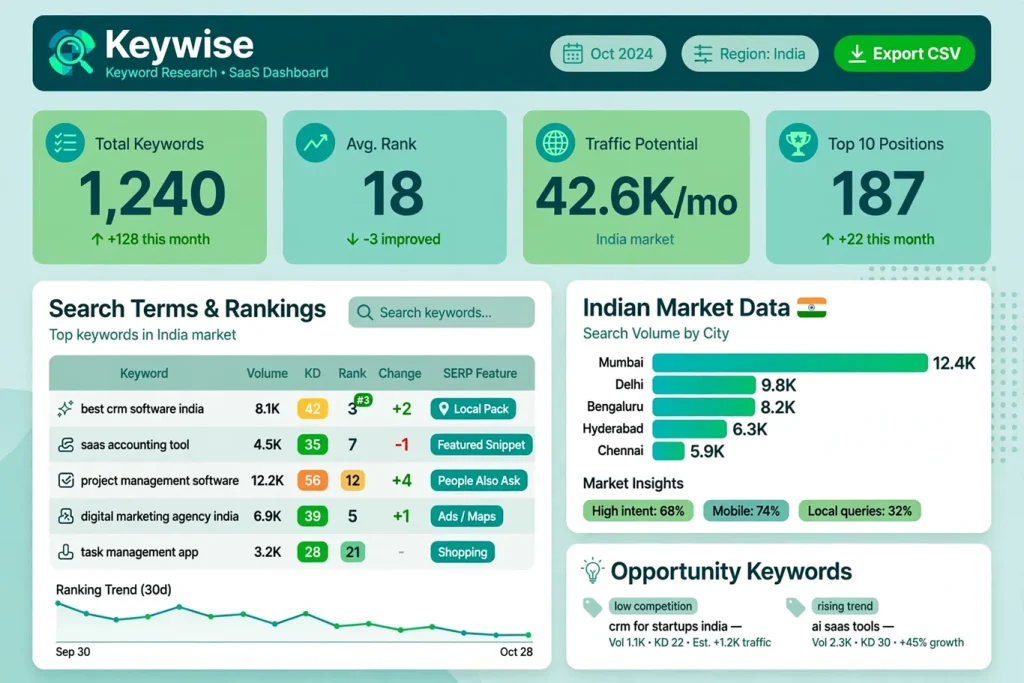
Indian buyers search in a mix of English and Hinglish, often include “India” in their query, and care about rupee pricing, GST billing, UPI payments and local support. Start with problems, not products. If you sell invoicing software, the problems include creating GST invoices, chasing late payments and tracking expenses, and each problem becomes a keyword family.
Next, build a seed list of 30 to 50 keywords covering product, problem, comparison and question terms, such as “best invoicing software India” and “invoicing software vs Tally”. Expand it with Search Console data, support tickets and competitor sites, then check India-specific volume and difficulty, aiming below 30 to 40 for first wins.
Now prioritise low-volume, high-intent keywords, where small Indian SaaS companies win. High-volume terms such as “CRM software” are dominated by global giants, while these realistic examples are far more winnable:
- “CRM software for real estate agents India”, around 100 to 300 searches per month, a buyer comparing options
- “HRMS software for startups under 50 employees India”, low volume, but the searcher is ready to evaluate
- “WhatsApp chatbot for D2C brands India pricing”, low volume, strong buying intent
- “Project management tool for architects India”, very low volume, but almost every click is a potential customer
- “GST billing software for textile business”, niche, low competition, clear industry fit
Each keyword may bring only 20 to 50 visitors a month, but five trial starts is real revenue. Map keywords to pages in a spreadsheet with four columns: keyword, intent, target page and status. For a deeper walkthrough, read our guide on keyword research for beginners in India.
Technical SEO Basics for SaaS Websites
Keep your structure flat: any important page should be reachable in three clicks from the homepage, with product, pricing, feature and comparison pages in the navigation or footer. Check robots.txt carefully: blocking useful pages by accident, or letting Google crawl login pages and dashboards, wastes crawl budget.
Google measures your site on mobile first, and many Indian users are on mobile data. Compress images, remove unused scripts, use a content delivery network, and aim for a Largest Contentful Paint under 2.5 seconds. A slow pricing page loses trials before a visitor reads it.
Control indexation deliberately. Product, pricing, feature, comparison, use-case, blog and documentation pages should usually be indexed, while login pages, account pages and staging subdomains should not. Use noindex tags where needed and canonical tags for duplicates. Add schema markup where it applies: SoftwareApplication on product pages, FAQ schema on FAQ sections, Review schema where you have genuine reviews, and BreadcrumbList for navigation. Test it with Google’s Rich Results Test, since incorrect schema is worse than none. For a full checklist, see our technical SEO audit guide for India.
Content Types That Work for SaaS SEO
Blog articles alone will not grow a SaaS business: the highest-converting content is commercial and product-led. Comparison pages target buyers who have shortlisted two or three products, for example “Your Product vs Zoho”. Be honest, listing real features, rupee pricing and limitations, since a biased comparison loses trust and the sale. Alternative pages target users unhappy with a competitor, such as “Best alternatives to Tally for invoicing”: explain who it suits, what it does better, and how to migrate.
Use-case pages show how your product solves a problem for a specific audience, such as “Invoicing software for freelancers in India”. They rank for niche, high-intent keywords and convert better than generic feature pages because the visitor sees themselves in the content. Give each major feature its own page too, optimised for the keyword people use to search for it, such as “automated payment reminders” or “GST e-invoicing”.
Your documentation is an underused SEO asset. Buyers search “how to” questions, and a clear docs article can rank for them and introduce new users to your product. Write docs in plain language, answer the question in the first paragraph, and link to related features. Docs also perform well in AI search, which prefers clear, factual, step-by-step answers. Blog articles still matter, but they should support commercial pages, not replace them. Every post should link to a relevant product or comparison page, and every commercial page should link back to supporting content. That structure turns traffic into trials.
AI Search and GEO Basics for SaaS
Generative Engine Optimisation, or GEO, means making content easy for AI tools to find, understand and cite. In 2026, a growing share of Indian SaaS buyers start research in an AI tool rather than Google, and if your content is never cited there, you are invisible to them. Good SEO and good GEO overlap heavily, since AI tools favour clear, factual, well-structured content. Answer questions directly, with a concise answer in the first paragraph of each section and detail below it. Use descriptive headings and lists, include real data such as rupee prices and feature comparisons, and keep facts current by reviewing top pages every quarter. Build brand mentions through reviews, directories and guest articles, because AI tools recommend brands they see mentioned across the web. Finally, do not block AI crawlers such as GPTBot and ClaudeBot in robots.txt without a deliberate decision, since blocking them means those tools cannot cite your pages. You need one content strategy that serves Google, AI Overviews and AI chatbots with clarity and accuracy.
How Much Does SaaS SEO Cost in India in 2026?
Google Search Console and Google Analytics 4 are free. A keyword tool such as Semrush or Ahrefs costs Rs. 10,000 to Rs. 25,000 per month for a basic plan, or Rs. 2,000 to Rs. 5,000 for a shared or lite tool. Rank tracking costs Rs. 1,500 to Rs. 5,000 per month and a content optimisation tool Rs. 3,000 to Rs. 8,000. A small team can start with free tools plus one paid keyword tool, at roughly Rs. 5,000 to Rs. 12,000 per month.
A freelance SEO consultant costs Rs. 25,000 to Rs. 80,000 per month and can handle strategy, technical fixes and content briefs. A freelance writer costs Rs. 1.5 to Rs. 4 per word, or Rs. 3,000 to Rs. 12,000 per article. An agency charges Rs. 50,000 to Rs. 2,00,000 per month for a SaaS retainer, and the cheapest agencies often deliver the weakest results. An in-house SEO specialist earns Rs. 50,000 to Rs. 1,20,000 per month in a metro city. The most cost-effective start is usually a freelance consultant plus one or two writers, at Rs. 50,000 to Rs. 1,00,000 per month, with a realistic first-year budget of Rs. 6,00,000 to Rs. 12,00,000. Compare that with ads: at Rs. 100 per click, 500 clicks a month costs Rs. 50,000, with nothing left when you stop paying. SEO builds an asset that keeps working, with ranking movement in three to six months and trial growth in six to twelve months.
Common Mistakes Indian SaaS Sites Make
Thin feature pages with two or three sentences cannot rank or build trust, so give every important page 400 to 800 words of useful content with screenshots and FAQs. Some teams block AI bots in robots.txt by accident and then wonder why they never appear in AI answers, so review that file and decide deliberately. Product pages without SoftwareApplication schema and FAQ sections without FAQ schema miss easy wins. Pricing pages that show only dollars, or hide pricing behind a sales call, lose Indian buyers who want rupees and GST explained. Much Indian B2B research starts on a phone, so a pricing or signup page that is hard to use on mobile loses trials. Blog posts written only to fill a calendar rarely rank or convert, since every article needs a purpose, such as ranking for a keyword or supporting a commercial page. Creating five near-identical pages for similar keywords causes cannibalisation, so keep one strong page per topic. Blog posts that never link to the product waste their traffic, so build internal links deliberately. Cheap backlink packages sold for Rs. 5,000 or Rs. 10,000 usually come from link farms and can trigger a penalty, so earn links through useful content and partnerships instead. Finally, a post bringing 10,000 visitors and zero trials is not a success, while a comparison page bringing 200 visitors and 20 trials is.
How to Measure SaaS SEO by Trials and Demos, Not Just Traffic
Traffic is easy to measure, which is why so many teams report it, but traffic is not revenue. For SaaS, the metrics that matter are trials, demo bookings and paying customers. First, create conversion events in Google Analytics 4 for trial signup started, trial signup completed, demo booked, pricing page viewed and contact form submitted, marking trial completions and demo bookings as key events. Second, link Search Console to Analytics so you can see which queries and landing pages lead to trials, not just clicks. A page ranking fifth but converting at 10 percent beats a page ranking first at 0.5 percent. Third, add UTM parameters to links shared in guest posts, directories and partnerships. Fourth, build a monthly report with five numbers: organic sessions, trial signups from organic search, demo bookings from organic search, trial-to-paid conversion rate, and revenue from organic trials. Fifth, review your top 20 organic landing pages monthly, checking trials, demos and conversion rate, and fix pages with traffic but no conversions first. Often the fix is simple: a clearer call to action, a shorter form, a rupee price or a testimonial.
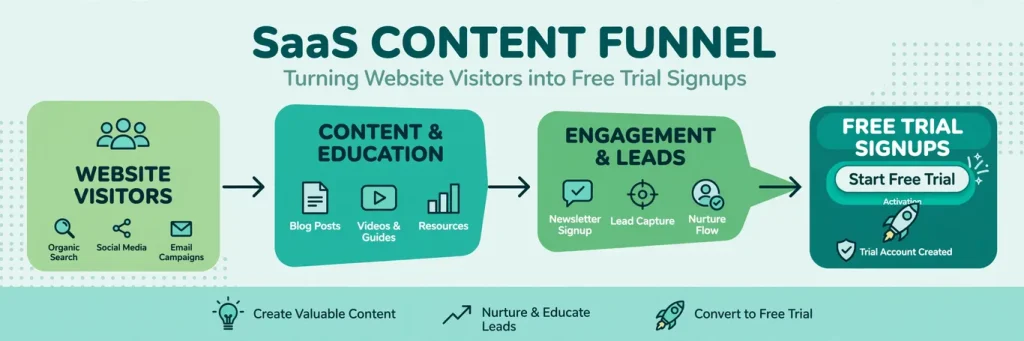
Consider a simple example. Your site gets 5,000 organic visits a month. Two percent start a trial, which is 100 trials, and 20 percent of those become paying customers, which is 20 customers. At Rs. 1,000 a month each, that is Rs. 20,000 in new monthly recurring revenue from SEO alone. Double your trial conversion rate to four percent and you double that revenue without doubling traffic. That is why conversion optimisation matters as much as ranking.
Frequently Asked Questions
How long does SaaS SEO take to work in India?
Most Indian SaaS sites see early movement for low-competition keywords in two to three months, meaningful traffic growth in four to six months, and consistent trial growth in six to twelve months. Results compound over time rather than arriving all at once.
How much should a small SaaS company in India spend on SEO?
A small team can start with Rs. 50,000 to Rs. 1,00,000 per month, covering one paid keyword tool, a freelance consultant and two to four articles a month. Competitive niches such as CRM or HR software may need Rs. 1,50,000 to Rs. 3,00,000 per month.
Is SaaS SEO different from SEO for other businesses?
Yes. SaaS buyers take longer to decide, compare several products, read documentation, and care about pricing, security and integrations. SaaS SEO therefore needs comparison, use-case, alternative and documentation pages, and must be measured by trials and demos, not only traffic.
Should Indian SaaS companies target global keywords or India-specific keywords?
Start with India-specific keywords if India is your main market. They have lower competition, clearer intent and better conversion rates, and they build authority before you compete globally. Expand to global keywords later with a separate plan.
What is GEO and does it matter for SaaS SEO in India?
GEO, or Generative Engine Optimisation, means making content easy for AI tools such as ChatGPT, Perplexity and Google AI Overviews to find and cite. It matters because more Indian buyers now ask AI tools for software recommendations. Clear answers, real data, rupee prices and structured headings improve your chances of being cited.
Can a small SaaS team do SEO without hiring an agency?
Yes. Many successful Indian SaaS companies started with a founder or one marketing hire, a freelance writer and a single keyword tool. Pick a small set of keywords, publish excellent pages, fix technical issues and measure trials. Hire an agency once SEO is proven and you need to scale.
Conclusion
SaaS SEO in India in 2026 rewards companies that are focused, honest and consistent. It is not about chasing the highest-volume keyword or publishing the most articles. It is about understanding how Indian buyers search, compare and decide, then building pages that serve each step of that journey. Start with a clean technical foundation and a clear keyword map, prioritise low-volume, high-intent keywords that larger competitors ignore, and build comparison, alternative, use-case and feature pages before scaling the blog. Use documentation as content, keep pricing in rupees, and make content easy for Google and AI tools to understand. Measure success by trials, demos and paying customers, not traffic alone. Follow the 90-day plan, stay consistent for six to twelve months, and keep improving your best pages. The companies that win in Indian SaaS search will not be the ones with the biggest budgets. They will be the ones with the clearest understanding of their buyers and the discipline to serve them well, one excellent page at a time.
