

Introduction
A boutique in Jaipur, a coaching centre in Indore, and a salon in Lucknow now share one habit. They reach customers on the same screens where India spends its evenings. Social media advertising is the most practical way for a small business in India to find new customers without a large brand budget. A modest daily spend can reach people in your own city who have never heard of your shop.
Yet many small businesses waste money on social ads: they boost a random post, target the whole country, and send clicks to a slow website. The problem is rarely the platform. It is the plan.
Why Social Media Advertising Works in 2026
Organic posts alone rarely reach enough people. Your followers see only a small share of what you publish, and strangers almost never find you by accident. Paid advertising solves that directly: you choose who sees your ad and how much you spend, and you can stop a campaign the moment it stops working.
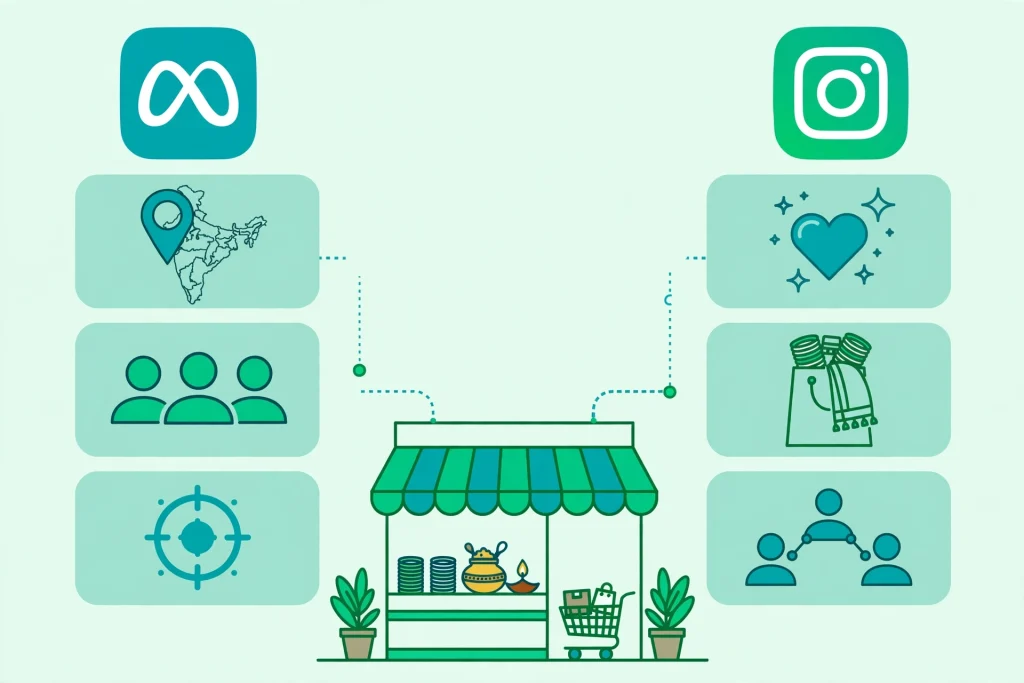
Three facts make social ads especially useful in India. Customers discover local businesses on their phones, often through Reels, Shorts, and Stories rather than search. Advertising can be tightly local, so a salon in Rohini can reach nearby neighbourhoods instead of paying to reach the whole country. And you can start small, increasing spending only when a campaign produces genuine enquiries or sales.
Which Platforms Deserve Your Budget
Pick one or two platforms where your customers spend time, and run them well.
- Instagram and Facebook (Meta): the default starting point for most consumer businesses in India, from fashion and food to coaching and retail.
- YouTube: the best choice when customers need to see how something works before they buy.
- LinkedIn: the right platform for business to business services, training, and hiring. It costs more per click, but the audience is far more specific.
- WhatsApp: not an ad platform on its own, but where many Indian customers prefer to enquire.
- X and regional apps: useful in narrow cases, but rarely the first choice for a small budget.
For most consumer brands, the winning combination is Instagram plus WhatsApp Business. For service and B2B businesses, LinkedIn plus YouTube often works better. Our guide to Meta Ads for Indian Small Businesses covers setup, formats, and audiences in greater depth.
Set Up Your Accounts First
Good campaigns start with clean setup. Create a Facebook Page for the business, not a personal profile, with the correct name, category, logo, and phone number. Switch Instagram to a professional Business account, complete the bio and contact details, then connect both in Meta Business Suite.
Use Meta Ads Manager, not just Boost Post. Boosting is quick, but Ads Manager gives you proper objectives, audience controls, and reporting. If you sell online, install the Meta Pixel or Conversions API. Set up a WhatsApp Business profile with a catalogue and quick replies, and use the same business name everywhere.
Choose the Right Campaign Objective
Meta asks what you want people to do, and your answer shapes who sees the ad. Pick the objective that matches your real goal.
- Awareness: opening a new shop, launching a brand, or entering a new locality.
- Traffic: sending people to your website, menu, or offer page.
- Engagement: increasing video views, post interactions, or messages.
- Leads: collecting enquiries for coaching, clinics, real estate, or travel.
- Sales: driving purchases, bookings, or signups you can track.
- Messages: starting WhatsApp or Instagram Direct chats.
A common mistake is choosing Sales when the business needs phone enquiries, or Traffic when the goal is footfall.
Targeting: Reach People Who Can Actually Buy
Targeting is the biggest advantage social advertising has over a newspaper or a hoarding, and it is also where most budgets leak.
Start with location. Choose a realistic area based on how far customers will travel. A restaurant in Karol Bagh should focus on nearby parts of Delhi, while a business that ships across India can target wider. Then add age: a playschool targets parents of young children, and a wedding photographer targets people planning weddings.
Use interests with care. Fitness interests suit a gym and food interests suit a bakery, but an interest is not proof of buying intent, so combine interests with location and age. Use Custom Audiences to reach people who already know you, such as past customers and video viewers. They are usually cheaper to convert, because the trust already exists. Try Lookalike Audiences once you have a good customer list.
How Much Should You Spend
There is no fixed price for a lead or a sale. Meta runs an auction, so your cost depends on audience, location, competition, objective, and ad quality.
The figures below are illustrative testing budgets, not official Meta prices.
| Daily budget | Approximate monthly budget | Suitable for |
|---|---|---|
| Rs. 100 | Rs. 3,000 | Small initial experiments |
| Rs. 200 | Rs. 6,000 | Testing local audiences and creatives |
| Rs. 300 | Rs. 9,000 | Regular local campaigns |
| Rs. 500 | Rs. 15,000 | More extensive campaign testing |
| Rs. 1,000 | Rs. 30,000 | Businesses ready to scale |
A daily budget of Rs. 200 to Rs. 300 is a practical starting point for many local businesses. Test two or three ad creatives against one audience. Judge the budget by the value of a customer, not by the cost of a click, and pause any ad above your maximum cost per genuine enquiry after a fair test.
Create Ads That Stop the Scroll
People scroll quickly, so your ad has about two seconds to earn attention. The best small business ads share a simple pattern: a specific benefit, a real photo or video, and one clear next step.
Write a specific headline. Avoid vague lines such as “Welcome to Our Business.” Say what you offer and where: “Best Cakes in Rohini, Order for This Weekend” says far more than a generic greeting. Use real photos and short videos, avoid blurry photos and stock pictures, and add captions, because many people watch with the sound off.
Design for mobile. Most Indian users see your ad on a phone in a vertical feed, so use vertical video and keep important text away from the edges. Hinglish and regional language captions often perform better in Tier 2 and Tier 3 cities. End with one clear call to action, such as “Send Us a WhatsApp Message.” One action per ad is enough.
YouTube Ads: The Gap Most Small Businesses Miss
Most Indian guides focus only on Meta, and that leaves a real opportunity open. YouTube is where customers go to learn, compare, and decide, and its ads reach people as they research a purchase.
YouTube offers skippable in stream ads, bumper ads, and Shorts ads. Start with a short video, 15 to 30 seconds, that shows the problem you solve and the result you deliver, such as a clinic explaining a treatment.
Target by topics and interests, keep the geography tight for local services, and send viewers to a page that continues the same message as the video. Judge success by enquiries and sales, not by views alone.
WhatsApp and Retargeting
An ad click is not a customer. What happens after the click decides whether your budget was well spent, and in India that next step is often WhatsApp. Click to WhatsApp ads let a person start a chat with one tap, without filling a form. Reply quickly, keep a clear business profile with a catalogue, and prepare answers to common questions. A slow reply sends a warm lead straight to a competitor.
Retargeting is the second half of the same idea. Most people do not buy on their first visit, so show a follow up ad to people who visited your website or watched your video. A gentle reminder or a limited offer often converts better than a cold ad to strangers, and it usually costs less. Our guide to Retargeting Ads for Indian Businesses explains how to build these audiences. Together, WhatsApp and retargeting close the loop most campaigns leave open.
Measure What Matters
Do not judge an ad by likes alone. Likes feel good, but they do not pay rent. Reach shows how many people saw the ad, which suits awareness but not sales. Click through rate shows the share of impressions that produced clicks.
The numbers that matter most are cost per lead, conversion rate, and return on advertising spend. Cost per lead is what you spend for one enquiry: spend Rs. 3,000 for 30 leads and your cost per lead is Rs. 100, but check how many leads are genuine. Conversion rate is how many enquirers become customers. Return on advertising spend is revenue attributed to the ad divided by ad spend. Return is not profit, because product costs still apply.
Track the full journey: enquiries, appointments booked, customers acquired, and revenue. Review results weekly. Pause what clearly fails, keep what works, and increase the budget in small steps.
Common Mistakes That Waste a Small Budget
Advertising without a clear objective means the platform optimises for the wrong action. Targeting everyone spends money on people who cannot buy. Poor images make people scroll past, and long, confusing copy buries the benefit. Ignoring mobile users is costly when most social browsing in India happens on phones. Spending too much too soon burns the test budget. Never testing alternatives means one weak headline decides the whole result. Ignoring enquiries loses customers to faster competitors, and sending clicks to a slow website wastes the traffic you paid for. If a campaign fails, change one thing at a time. Changing everything at once teaches you nothing.
Your First 30 Day Plan
In days 1 to 7, finish your page, Instagram profile, WhatsApp Business profile, and Ads Manager setup, shoot three short videos and five photos, and write three ad versions. In days 8 to 14, launch one campaign with a single objective, one local audience, and two or three creatives.
In days 15 to 21, pause the weakest creative, test a new headline or audience against the winner, and start a small retargeting audience. In days 22 to 30, increase the budget of the winning campaign in small steps, and plan next month around the best audience and creative. If a business to business audience worked well, test LinkedIn next. Our guide to LinkedIn Marketing for Indian B2B Brands explains how LinkedIn targeting and lead generation differ from Meta.
Plan festivals the same way: a teaser two weeks out, the main offer in the final week, and a thank you message after.
Frequently Asked Questions
How much should a small business spend?
Start with Rs. 200 to Rs. 300 per day for two weeks, and increase it only when the campaign produces genuine enquiries you can afford.
Which platform is best?
For most consumer businesses, Meta is the best starting point, because of its wide reach, local targeting, and low testing costs. YouTube suits businesses where customers need a demonstration.
Facebook ads or Instagram ads: which is better?
It depends on your customers. Facebook works well for local communities and service businesses, while Instagram works better for visual products. Run both, compare which brings better enquiries, and put more budget behind the winner.
How long does it take to see results?
You may see clicks within a few days, but a fair judgement needs one to two weeks of data. Strong results usually take a month of testing.
Do I need a website to run ads?
No. Many Indian small businesses run click to WhatsApp or lead form ads that collect enquiries without a website. A website helps if you sell online, but a WhatsApp Business profile and fast replies can work well on their own.
Conclusion
Social media advertising works for Indian small businesses when it is treated as a system, not a single boosted post. Choose one or two platforms where your customers spend time, set up your accounts properly, pick an objective that matches your real goal, and target people who can actually buy. Create specific, honest ads, give every ad one clear call to action, and close the loop with fast WhatsApp replies and retargeting. Measure enquiries and sales rather than likes, and scale the winners slowly.

2 Comments
Pingback: Google Ads vs Facebook Ads in India: Which Is Better in 2026?
Pingback: Instagram Marketing India: Grow Your Business in 2026