

Introduction
Ask five people what a website costs in India and you will get five answers: Rs 5,000, Rs 25,000, Rs 80,000, Rs 3 lakh, and even more. The confusing part is that all five can be honest. They are quoting for completely different things. A Rs 5,000 website and a Rs 3 lakh website are about as similar as a scooter and a delivery truck.
This guide gives you the straight answer for 2026. You will learn the realistic price ranges by website type, what changes the price, what it costs to build it yourself versus hiring a freelancer or an agency, the recurring costs nobody mentions upfront, how GST affects your bill, and a checklist for comparing quotes fairly. All figures are typical market ranges seen in India in 2026, not fixed quotes, so use them to plan and to spot quotes that are suspiciously cheap or needlessly expensive.
The Short Answer: Website Cost Ranges in India in 2026
If you only need the numbers, here they are. A basic template website with 3 to 5 pages typically costs Rs 8,000 to Rs 30,000. A custom business website with 5 to 15 pages, a blog and basic SEO usually costs Rs 40,000 to Rs 1,50,000. An online store on Shopify or WooCommerce usually costs Rs 50,000 to Rs 3,00,000. A custom web application, portal or SaaS product starts around Rs 3,00,000 and can cross Rs 15,00,000.
For most Indian small businesses, a service provider, consultant, clinic, coaching business or local retailer, the realistic budget for a website that actually generates enquiries is Rs 60,000 to Rs 1,50,000. Anything far below that is usually a template installation with minimal customisation and no SEO foundation. Anything far above it should come with a clear explanation of what extra work you are paying for.
Cost by Website Type
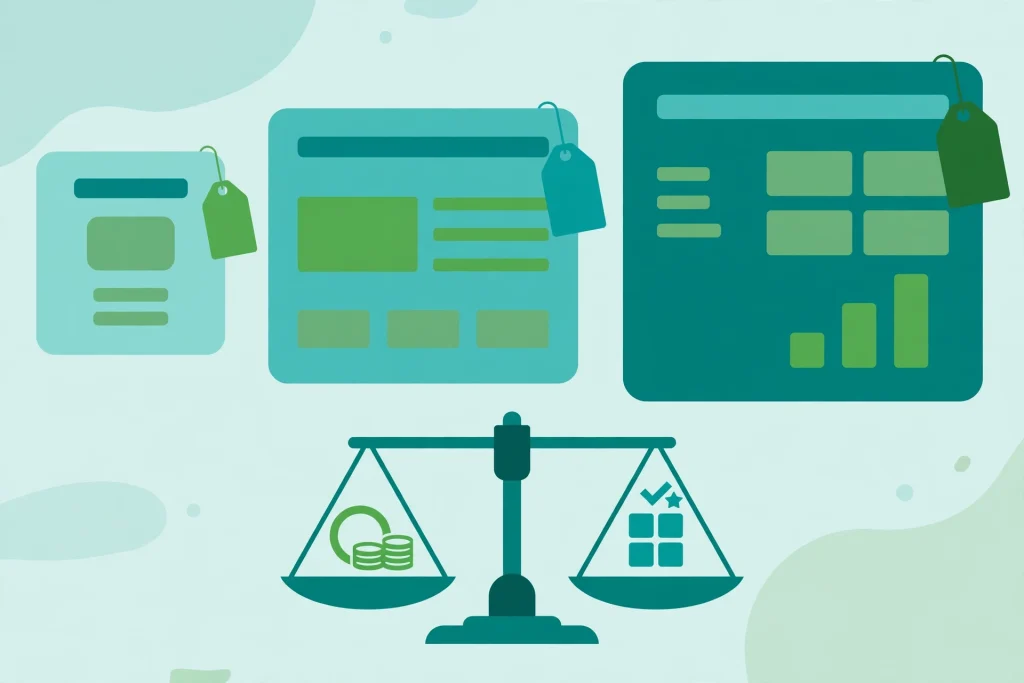
The type of website is the biggest factor in the price. A one-page landing page built around a single goal, such as collecting leads for one service, costs about Rs 7,000 to Rs 15,000. It is quick to build and easy to test, which makes it a good choice for a single campaign.
A brochure or basic business website with 5 to 10 pages, a contact form and mobile-friendly design costs Rs 15,000 to Rs 75,000. This is the most common choice for small businesses that need a professional presence and a way for customers to contact them.
A standard business website with custom design, a content management system, a blog, on-page SEO and enquiry tracking costs Rs 40,000 to Rs 2,00,000. The range is wide because design quality, the number of pages and the SEO work vary a lot.
An e-commerce store with up to 100 products, a payment gateway, shipping setup and order management costs Rs 60,000 to Rs 5,00,000. Shopify stores sit at the lower end of that range, while custom WooCommerce stores with special features sit higher. A store with thousands of products, custom filters, multi-vendor features or app integrations starts around Rs 3,00,000.
A custom web application, such as a booking platform, a marketplace or a SaaS product, starts around Rs 3,00,000 and can go well past Rs 25,00,000. These are priced per feature, not per page, and the price depends on the complexity of the user accounts, payments, dashboards and integrations.
Cost by Who Builds It
Who builds the website changes the price as much as what is built. Building it yourself on Wix, Squarespace or WordPress costs almost nothing in labour, but you still pay roughly Rs 4,000 to Rs 15,000 a year for the platform, domain and hosting. DIY is the cheapest route and the slowest, because you learn everything as you go, and the result depends on your eye for design.
A freelancer in India usually charges Rs 8,000 to Rs 50,000 for a small business website, depending on experience and the city. Freelancers are cheaper than agencies and often faster for small projects, but you depend on one person for design, development, SEO and support. Check their past work carefully and ask who maintains the site after launch.
A small studio or agency charges Rs 25,000 to Rs 1,50,000 for a polished, custom-built small business site. You pay for a team: a designer, a developer, an SEO person and a project manager. Agencies cost more, but they are the right choice when the website is a serious sales tool and you want one accountable partner.
A large agency in a metro city can quote Rs 2 lakh and above for the same project, mostly because its overheads are higher. Large agencies make sense for big brands and complex projects, not for a first website.
AI website builders are a new option in 2026. They generate a site from a short description in minutes, and they cost little. They are useful for a quick landing page, but the design is generic, the SEO control is limited, and moving away later can be difficult. Treat them as a starting point, not a finished business website.
What Makes the Price Go Up or Down
Seven factors move the price more than anything else. The number of pages matters: a 5-page site costs far less than a 30-page site. Custom design costs more than a template, but it also looks better and converts better. A content management system such as WordPress lets you edit pages yourself, and it adds to the build cost.
Features add cost quickly. A payment gateway with UPI, a booking system, a customer login area, a multilingual version or a custom calculator each add hours of work. Content is often forgotten: if the developer must write your text and find your photos, expect to pay for it. SEO setup, including keyword research, meta tags, speed optimisation and schema markup, is real work and should be priced separately. Finally, timelines matter. A rush job in one week costs more than the same job delivered in four weeks.
When you compare quotes, check which of these are included. A cheap quote that excludes content, SEO and training is not cheaper than a higher quote that includes them.
The Yearly Costs Nobody Mentions Upfront
A website is a running system, not a one-time purchase. Plan for yearly running costs of roughly 15% to 25% of the build cost, more if you run ongoing SEO or paid tools.
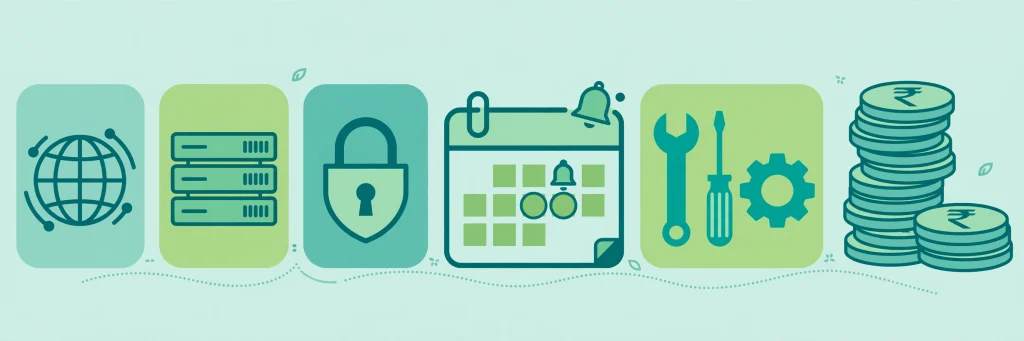
A domain name costs roughly Rs 800 to Rs 1,500 a year. Hosting costs Rs 2,000 to Rs 8,000 a year for shared hosting on a small site, and Rs 5,000 to Rs 50,000 a year for better hosting or a busy store. An SSL certificate is usually free with good hosting, but some providers charge for it. Business email costs a few hundred rupees per user per month.
Premium themes and plugins often renew yearly, typically Rs 2,000 to Rs 10,000 a year in total. A maintenance plan, where someone updates WordPress, plugins and backups and fixes small issues, typically costs Rs 2,000 to Rs 15,000 a month through an agency, or Rs 3,000 to Rs 15,000 a month for a freelancer retainer.
A useful rule of thumb: the first-year total cost of ownership is typically 40% to 70% higher than the quoted build cost alone, once you add the domain, hosting, email, plugins and maintenance. Budget for it from the start so the site does not go stale after three months.
GST: The 18% You Must Add
Web development services in India attract 18% GST. A Rs 1,00,000 agency quote becomes Rs 1,18,000 after GST. Always confirm before signing whether quoted prices are inclusive or exclusive of GST. Freelancers below the GST registration threshold may not charge GST, but they also cannot give you an input tax credit. If your business claims GST credit, ask for a proper tax invoice.
How to Compare Quotes Fairly
Never compare quotes on price alone. Ask every vendor the same questions and compare their answers. What exactly is included: number of pages, design, content writing, images, SEO setup, speed optimisation, training and support? Who owns the domain, hosting and the website files? What happens after launch: how many months of support are included, and what does a change cost later? What is the timeline, and what do they need from you to hit it?
A good quote lists deliverables, timelines and exclusions in writing. A vague quote that says “website development: Rs 25,000” with no detail is a warning sign. Ask for two or three recent projects in your industry and actually open them on your phone. Check whether they load fast, look clean and make it easy to contact the business.
Watch for red flags. A quote far below the market range usually means a template resold as custom work, or content and SEO quietly excluded. A vendor who cannot show live work, has no written contract, or asks for 100% payment upfront is a risk. A fair payment schedule is typically 40% to 50% upfront, the rest on delivery milestones.
Cost by Business Type: Worked Examples
A local clinic website with 8 pages, appointment booking, doctor profiles and local SEO typically costs Rs 40,000 to Rs 90,000 to build, plus Rs 15,000 to Rs 30,000 a year to run. A restaurant website with a menu, online ordering and Google Maps integration typically costs Rs 30,000 to Rs 80,000. A coaching institute website with course pages, enquiry forms and WhatsApp lead capture typically costs Rs 50,000 to Rs 1,20,000. A D2C brand store with 50 products, UPI payments and shipping typically costs Rs 80,000 to Rs 2,50,000. A real estate website with project pages, filters and a CRM connection typically costs Rs 1,00,000 to Rs 3,00,000.
These are planning ranges, not quotes. Your exact price depends on your pages, features and who builds it, but they show why a single number for “a website” is meaningless without knowing the business behind it.
How to Write a Brief That Gets You Good Quotes
A short brief saves you money, because vendors quote accurately instead of guessing. Your brief should state what the business does, who the website is for, the goal of the site, such as calls, WhatsApp enquiries or online sales, the pages you need, the features you need, such as payments or booking, examples of websites you like, your budget range and your deadline. Send the same brief to three vendors and compare their quotes line by line. The cheapest quote is rarely the best, and the most expensive is rarely justified without a clear reason.
Our guide to Web Development Trends in India for 2026 explains which features are worth paying for this year, such as speed, mobile-first design and AI search visibility. If your current site is old, read our Website Migration Checklist for Indian Businesses before you rebuild, so you do not lose your Google rankings. And if your customers search in more than one language, our guide to How to Create a Multilingual Website for Indian Businesses in 2026 shows what translation adds to the cost.
Common Mistakes to Avoid
- Choosing the cheapest quote without checking what is excluded, then paying more later for content, SEO and fixes.
- Forgetting GST, so the final bill is 18% higher than the budget.
- Ignoring yearly running costs and letting the site go stale after launch.
- Paying 100% upfront with no written contract or milestones.
- Buying a website with no plan for who updates it and how often.
- Judging a website by how it looks on a desktop, when most Indian visitors arrive on a phone.
- Skipping SEO setup to save money, then wondering why Google sends no visitors.
FAQ
How much does a basic website cost in India in 2026?
A basic website with 3 to 5 pages typically costs Rs 8,000 to Rs 30,000 if built from a template, or Rs 15,000 to Rs 40,000 for a small custom build by a freelancer or small studio. It usually includes a contact form and mobile-friendly design, but not advanced SEO or lead generation features.
How much does an e-commerce website cost in India?
A small online store with up to 100 products, UPI payments and shipping typically costs Rs 60,000 to Rs 3,00,000 on Shopify or WooCommerce. A larger store with custom features, thousands of products or multi-vendor support starts around Rs 3,00,000 and can cross Rs 15,00,000.
What are the hidden costs of a website in India?
The usual hidden costs are the domain renewal (Rs 800 to Rs 1,500 a year), hosting (Rs 2,000 to Rs 50,000 a year), business email, premium plugin renewals, maintenance (Rs 2,000 to Rs 15,000 a month) and 18% GST on the build cost. Together they typically add 15% to 25% of the build cost every year.
Is it cheaper to build a website myself?
Yes, in money but not in time. A DIY website costs roughly Rs 4,000 to Rs 15,000 a year for the platform, domain and hosting, but you spend your own hours learning and building, and the design and SEO depend on your skill. For a business website that must generate enquiries, a freelancer or small agency usually pays for itself.
How long does it take to build a website in India?
A basic 5-page website takes 1 to 3 weeks. A standard business website takes 3 to 6 weeks. An e-commerce store takes 4 to 8 weeks. A custom web application takes 2 to 6 months. Delays usually come from content: if your text and photos are ready, the build goes much faster.
Should I pay for website maintenance every month?
Yes, if the website matters to your business. WordPress, themes and plugins need updates, backups and security checks. Without maintenance, a site slowly breaks, slows down and becomes vulnerable. A basic maintenance plan at Rs 2,000 to Rs 5,000 a month is enough for most small business sites.
Conclusion
There is no single price for a website in India, because a one-page site and a custom store with payments are different jobs. The honest answer for 2026 is that a basic site costs Rs 8,000 to Rs 30,000, a professional business website costs Rs 40,000 to Rs 1,50,000, an online store costs Rs 60,000 to Rs 3,00,000, and a custom application starts around Rs 3,00,000. Add 18% GST and 15% to 25% of the build cost every year for running costs, and budget the first-year total, not just the build quote. Write a clear brief, get three quotes, compare what is actually included, and pick the vendor whose work you have seen and whose contract you understand. The cheapest website is usually the most expensive one in the end, because you pay twice: once to build it, and once to fix it.

4 Comments
Pingback: Best Hosting in India 2026: 9 Hosts Compared
Pingback: Best Free Website Builders in India 2026
Pingback: How to Create a Portfolio Website in India 2026: Platforms, Costs and Examples
Pingback: How to Create a Restaurant Website in India 2026: Platforms, Costs and Online Ordering