


Introduction
AI can now produce a full draft in minutes, but a draft is not an article. Indian writers who publish AI output without editing soon notice the same problems: the text sounds polished yet generic, the examples could belong to any country, a confident statistic turns out to be invented, and readers leave without trusting the author. Editing is where the value is added, and it is a skill worth systematising.
This checklist gives you a repeatable 20-minute editing workflow for AI-assisted drafts. It covers reader fit, removing AI tells, adding proof, finding your voice, tightening structure, fact checking, and a final SEO and read-aloud pass. It also covers India-specific details that generic checklists miss, from Indian English and rupee pricing to local examples and legal caution. Use it on every AI-assisted post, and your output will sound human because it has been genuinely edited by one.
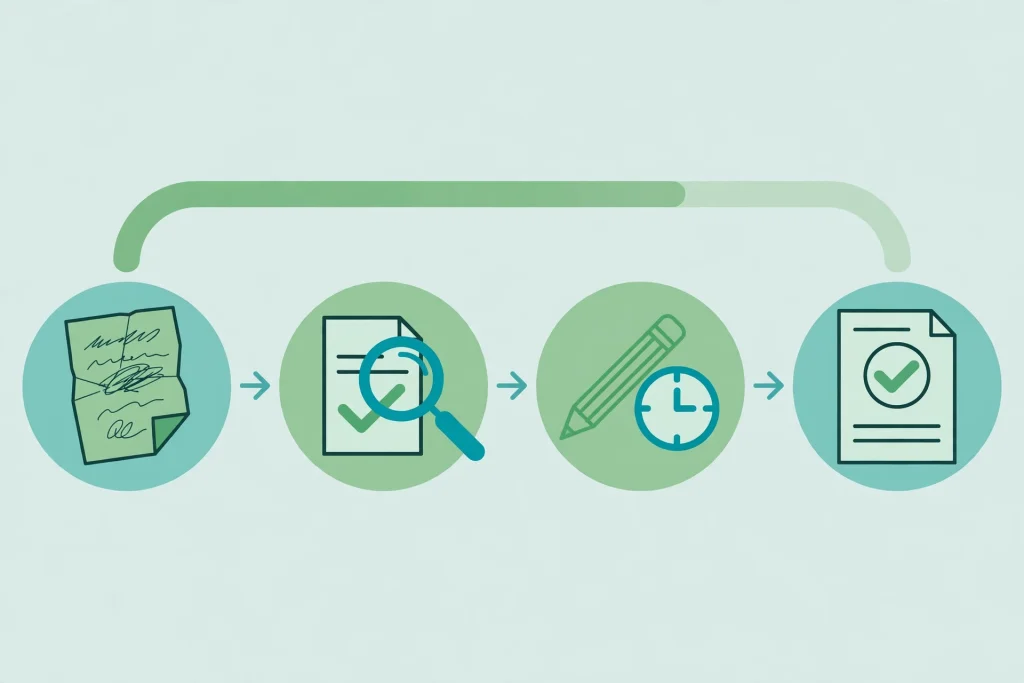
Why AI Drafts Need a Human Editor
AI writing tools are excellent at structure and fluency, and weak at judgement. A model can organise headings, vary sentence length, and produce smooth transitions. It cannot know whether an example will resonate with a reader in Jaipur, whether a price quoted is current in India, or whether a claim about a product is true. Those decisions belong to the writer.
There is also a search reason to edit properly. Search engines do not punish content simply for being AI-assisted, but they do demote scaled, low-value content that adds nothing new. A draft that repeats what every other page says, with no original example, no verified fact, and no point of view, is exactly that kind of page. Editing is what turns a commodity draft into a page worth ranking.
Think of the roles clearly: AI writes the first draft, you make the decisions. You decide the reader, the angle, the examples, the claims worth keeping, and the final wording. If you cannot defend a sentence to a reader, cut it or prove it. That standard alone will improve most AI drafts more than any rewriting tool.
Pass 1: Fix the Reader Fit (Minutes 0 to 3)
Before touching grammar, name the reader in one sentence. Who is this for, what problem are they solving, and what should they be able to do after reading? If the draft could serve any reader, it serves none well, so rewrite the introduction to speak to your specific reader.
Check the opening paragraph hardest. AI introductions usually define the topic at length before naming the problem. Cut the definition, name the pain in the first two sentences, and promise the outcome. A reader who recognises their own problem in the opening will keep reading. A reader who gets a textbook definition will leave.
Adjust the knowledge level. A draft written for beginners should explain terms and show steps. A draft for experienced marketers should skip basics and get to trade-offs, costs, and examples. Mismatched depth is a common AI failure, and fixing it early saves rewrites later.
Pass 2: Remove the AI Tells (Minutes 3 to 7)
AI tells are not mysterious. They are patterns readers feel even when they cannot name them: repeated transition words, vague benefit claims, symmetrical sentences, and phrases that sound like a brochure. Hunt for them deliberately.
Cut or rewrite these habits wherever they appear:
- Empty scene-setting openings about a fast-changing digital world
- Phrases that delay the point, such as noting that something is important without saying what it is
- Broad claims with no example, number, or source behind them
- Three-item lists that repeat the same idea in different words
- Conclusions that merely restate the introduction
Vary sentence length as you go. AI drafts often settle into uniform medium-length sentences. Break a long sentence into two, merge two short ones where the rhythm needs it, and read the paragraph back. If it sounds like it could have been written by anyone, it still needs a decision, an example, or an opinion.
Pass 3: Add Proof and Specificity (Minutes 7 to 12)
This is the pass that separates edited content from polished filler. For every important claim, ask what proof a sceptical reader would accept. Often the answer is a concrete example, a screenshot of your own process, a named tool with its actual price in rupees, or a first-hand observation from your own work.
Replace generic examples with Indian ones where the audience is Indian. A pricing example in dollars, a delivery example built around a US retailer, or a festival reference that ignores Diwali, Holi, and regional holidays will feel imported. Local detail is not decoration: it signals that the writer knows the reader’s world. If you write about tools, check current Indian pricing and free-plan limits rather than repeating what the draft claims. For a starting point on choosing tools wisely, see this guide to the best AI writing tools for Indian creators in 2026.
Do not invent proof to fill a gap. If you cannot verify a statistic, a quote, or a case study quickly, cut the claim or soften it to something you can stand behind. A shorter honest article outranks a longer article with one exposed fabrication, because trust, once lost, is hard to rebuild.
Pass 4: Put Your Voice and Judgement In (Minutes 12 to 15)
Voice is not slang, jokes, or forced friendliness. Voice is judgement: a clear position, an honest trade-off, and a willingness to say what you would not recommend. Add at least one sentence per major section that only you could write, such as a preference, a warning from experience, or a decision rule you actually use.
Build a short voice card if more than one person touches your content. Four lines are enough: how you sound, what you avoid, what you prefer, and what you never publish. Examples of useful rules are “short paragraphs and direct verbs”, “no unsupported statistics”, and “Indian examples first”. A vague card that says “friendly and professional” will not prevent generic writing. Specific bans will.
Keep the writer’s perspective consistent. If the article promises a practical guide, do not drift into theory halfway through. If it promises an opinion, do not hide behind neutral summaries. Readers trust writers who take a position and explain it, even when they disagree.
Pass 5: Tighten Structure and Flow (Minutes 15 to 17)
Good structure lets busy readers scan and still learn. Check that every H2 heading describes what its section delivers, not just its topic. “Editing for SEO” is a topic. “Edit for search: headings, answers, and internal links” is a promise a reader can act on.
Cut paragraphs that repeat an earlier point, merge sections that cover the same ground, and move the strongest example to the top of its section. Check transitions: each section should follow naturally from the last, and any jump should be bridged with one sentence, not a filler paragraph.
This is also the moment to check internal links. Link to related posts where they genuinely help the reader go deeper, using descriptive anchor text rather than “click here”. A post on ranking fundamentals pairs naturally here: this guide on how to write blog posts that rank in India covers the on-page habits your edited draft should already follow.

Pass 6: Fact-Check Everything That Could Hurt Trust (Minutes 17 to 19)
Fact checking is non-negotiable for AI-assisted content. Models invent statistics, misattribute quotes, describe features that do not exist, and present outdated prices as current. Check every number, date, name, price, and product claim against a primary source before publishing.
Prioritise by risk. Health, finance, legal, and safety advice must be checked line by line, and risky claims should be removed if you cannot verify them. For general advice, verify anything a reader might act on or repeat: tool capabilities, costs, deadlines, and step-by-step instructions. If a step in a tutorial does not work when you try it, fix the tutorial, not the reader’s expectations.
Watch for India-specific errors in particular: GST treatment, UPI limits, platform availability in India, and regional regulations. An AI draft may confidently describe a feature that is US-only or a rule that changed in 2025. A two-minute search per risky claim prevents the kind of error readers screenshot and share.
Pass 7: Final SEO and Read-Aloud Check (Minute 19 to 20)
Finish with a short mechanical pass. Confirm the focus keyword appears naturally in the title, introduction, and at least one heading, without stuffing. Check the meta description reads like a human invitation to click, not a keyword list. Confirm images have descriptive alt text, headings follow a logical order, and internal and external links work.
Then read the article aloud, or at least the introduction and one middle section. Your ear catches what your eye misses: sentences you run out of breath on, repeated openings, awkward rhythm, and places where the tone suddenly shifts. Split long sentences, cut words that add nothing, and fix any sentence you stumble over. If you would not say it in a conversation with a reader, rewrite it.
Editing for Indian Readers: Details Generic Checklists Miss
Indian English has its own rhythm and vocabulary, and edited content should respect it rather than flatten it into generic global English. Use terms your readers use, such as lakh and crore where they clarify amounts, and spellings your audience expects. At the same time, avoid Hinglish filler in a professional guide unless your brand voice genuinely uses it: consistency matters more than any single word choice.
Prices, dates, and platforms should be local and current. Quote in rupees with the year or plan name, name Indian payment methods where relevant, and mention festival and holiday timing when a publishing or marketing schedule depends on it. A checklist that ignores the Indian calendar will give advice at the wrong moment.
Be careful with claims about earnings, health outcomes, exam results, and legal matters. Indian readers act on such advice, and regulators and platforms increasingly penalise exaggerated promises. Where a result varies by person, say so plainly, and where you are not an expert, point readers to one rather than guessing.
Running This Checklist as a Team
For teams, turn the checklist into a shared document with a checkbox per pass and a named owner for fact checking. The writer runs passes 1 to 5, a second person runs pass 6, and the final read-aloud check happens after all edits, not before, so late changes get caught too.
Keep a log of recurring AI errors your team finds: invented statistics, outdated prices, US-centric examples, and repeated phrases. Add the worst offenders to your voice card as banned patterns. Over a month, this log becomes a style guide that makes every future edit faster.
For older AI-assisted posts that were published lightly edited, do not leave them as they are. Apply the same checklist during a content refresh: verify facts, replace generic examples, tighten structure, and update internal links. This refresh strategy for older posts in India explains how to prioritise which posts to fix first for the biggest ranking return.
Common Editing Mistakes to Avoid
The most common mistake is polishing the surface while leaving the substance generic: swapping a few words, adding contractions, and calling the draft human. If the paragraph still refuses to take a position or offer proof, it is not edited yet.
Other traps include trusting AI detector scores as a quality measure, over-editing until the article loses its structure, and adding proof that is itself unverified. Detectors are unreliable judges, structure should be fixed before wording, and a citation to a weak source is worse than no citation, because it borrows credibility it has not earned.
Finally, do not let the checklist become a bottleneck. Twenty minutes is a target for a standard post, not a law. Short news posts may need ten minutes, and high-risk guides may need an hour. The point is a consistent process, not a stopwatch.
FAQ
How long should editing an AI draft take?
For a standard blog post, 15 to 20 minutes of focused editing is realistic once the checklist is familiar. If you are still fixing basic structure after 30 minutes, the prompt or outline was probably too weak, and improving the brief will save more time than more editing.
Should I disclose that I used AI?
Disclose AI assistance where your readers, clients, or platform expect it, and always take responsibility for the final content as its author. Transparency builds trust, and it never replaces the need to verify facts yourself.
Can AI detectors tell whether my edited post used AI?
Not reliably. Detectors give estimates, not verdicts, and they flag human writing too. Judge a draft by accuracy, specificity, and usefulness, not by a detector score.
What should I fact-check first in an AI draft?
Start with statistics, prices, dates, product features, quotes, and any health, finance, or legal claim. Those are the areas where AI errors are most common and most damaging.
Does human editing help SEO?
Yes, because editing adds original examples, verified facts, clear structure, and reader-focused answers, which are exactly what search systems reward. Editing does not guarantee rankings, but unedited generic content rarely earns them.
How do I keep a consistent voice across AI-assisted posts?
Use a short voice card with specific rules and banned patterns, run the same checklist on every post, and have one editor own the final read-aloud pass. Consistency comes from process, not from any single tool.
Conclusion
An AI draft is raw material, not a finished article. The editing checklist in this guide turns that material into something readers can trust: a named reader, a clear point of view, verified facts, Indian context, tight structure, and a final read that sounds like a person wrote it. Competitor checklists often stop at surface polish. Yours should not.
Start with your next draft. Run the seven passes, time yourself honestly, and note which pass changes the article most. For most writers it is proof and fact checking, because those are the passes no tool can do for you. Do them well, and your AI-assisted content will read as human for the best possible reason: a human genuinely edited it.
