
Introduction
Every Indian small business owner knows the same frustration. A customer asks about your product on Instagram at 11 pm, and by the time you reply the next morning they have bought from someone else. This is not a marketing problem. It is a follow-up problem, and follow-up is exactly what marketing automation fixes.
Marketing automation means setting up simple systems that send the right message at the right time without you doing it by hand every time. This guide gives you three starter stacks, a price comparison, two workflows, WhatsApp rules, and a 30-day ROI plan.
What Marketing Automation Really Means for a Small Business
Forget the jargon. Marketing automation is four simple jobs done automatically: capture, reply, remind, and re-engage. Capture means every enquiry from your website, Instagram, Google Business Profile, or WhatsApp lands in one list instead of five inboxes. Reply means the customer gets an instant acknowledgement, even at midnight. Remind means a customer who showed interest gets a well-timed follow-up instead of silence. Re-engage means a past buyer hears from you again with something relevant.
Start with reply and remind, which fix the biggest leaks: slow replies and zero follow-up. If slow replies and missed follow-ups are not your problem, your problem is probably traffic, not follow-up. In that case read our guide to Email Marketing for Small Businesses in India first, because a good email list is the foundation every automation setup is built on.
Starter Stack 1: The Free Stack at Rs 0 a Month
The free stack proves the concept before you spend a rupee.
The tools: HubSpot CRM free plan for contacts and deal tracking, Brevo free plan for email (up to 300 emails a day), WhatsApp Business app (free) for replies and catalogues, and Google Forms for enquiry capture.
How it works: A customer fills your form or messages you on WhatsApp. You add them to HubSpot, which stays organised as the list grows. Brevo sends a welcome email and a monthly offer email automatically. WhatsApp Business handles instant replies with quick replies and away messages.
The honest limits: Brevo free caps you at 300 emails a day, HubSpot free has no automation workflows, and the WhatsApp Business app is manual. You will still spend time on follow-ups, but far less than before, and you will stop losing enquiries entirely.
Starter Stack 2: The Stack Under Rs 2,000 a Month
This is the sweet spot for most Indian small businesses: a shop, a clinic, a coaching centre, or a service business with 500 to 2,000 contacts and a real need for automatic follow-up.
The tools: Brevo Starter for email automation, Zoho CRM free or standard for contacts and deals, and the WhatsApp Business app.
How it works: Brevo Starter unlocks real automation: a welcome sequence for new subscribers, an abandoned cart sequence for an online store, and a re-engagement sequence for customers who have gone quiet. Zoho CRM tracks every enquiry as a deal with a stage, so you can see at a glance how many enquiries are waiting, in discussion, or closed.
What it costs: Brevo Starter starts at about Rs 1,600 to Rs 2,000 a month, so check the official pricing page before you buy. Zoho CRM Standard is about Rs 1,000 to Rs 1,200 per user per month. All prices exclude GST, so add 18 percent GST to your final bill.
Starter Stack 3: The Stack Under Rs 5,000 a Month
This stack is for a growing business with 2,000 to 10,000 contacts, an online store or a busy enquiry flow, and a need for WhatsApp automation at scale.
The tools: Zoho Marketing Automation or Freshworks CRM as the core system, Brevo or Zoho Campaigns for email, and an official WhatsApp Business API provider for automated WhatsApp messages.
How it works: Every channel runs from one place. A new website enquiry triggers a welcome email and a WhatsApp message in sequence. A cart abandonment triggers a reminder after two hours and an offer after 24 hours. A past buyer gets a reorder reminder at the right interval.
What it costs: Zoho Marketing Automation starts at about Rs 3,500 to Rs 4,500 a month, so check the official pricing page for the current figure. Freshworks CRM growth plans start at about Rs 2,500 to Rs 3,000 per user per month, and WhatsApp Business API messages cost extra, usually about Rs 0.35 to Rs 0.80 per message. A realistic total for a single-user setup with moderate WhatsApp volume is about Rs 4,000 to Rs 5,000 a month including GST.
Full Rupee Price Comparison
Prices change often, so check each tool’s official pricing page before you buy. All figures exclude GST.
| Tool | Free plan | Paid plan from | Free plan limits | Watch out for |
|---|---|---|---|---|
| Brevo | Yes, 300 emails a day | About Rs 1,600 a month | 300 emails a day, no automation | Cost rises with email volume |
| Mailchimp | Yes, 500 contacts | About Rs 1,100 a month | 500 contacts, 1,000 sends a month | Price jumps as contacts grow |
| HubSpot CRM | Yes, generous free CRM | About Rs 1,800 a month | No automation on free | Paid tiers get expensive fast |
| Zoho CRM | Yes, 3 users free | About Rs 1,000 per user a month | 3 users, limited features | Add-ons add up quietly |
| Zoho Campaigns | Yes, 2,000 contacts | About Rs 400 a month | 2,000 contacts, 6,000 emails | Best if you already use Zoho |
| Freshworks CRM | Yes, limited free tier | About Rs 2,500 per user a month | Basic features only | Per-user pricing multiplies |
| WebEngage | Trial only | About Rs 8,000 a month upwards | No real free tier | Built for scale, not tiny lists |
| MoEngage | Trial only | Custom pricing | No real free tier | Best for apps and high volume |
The true cost of a tool is the price when your contacts double, so calculate the price at double your current list size before you commit.

Workflow 1: New Enquiry to WhatsApp Follow-Up
This is the workflow every Indian small business should build first, because it fixes the most expensive leak: the enquiry that never gets a reply.
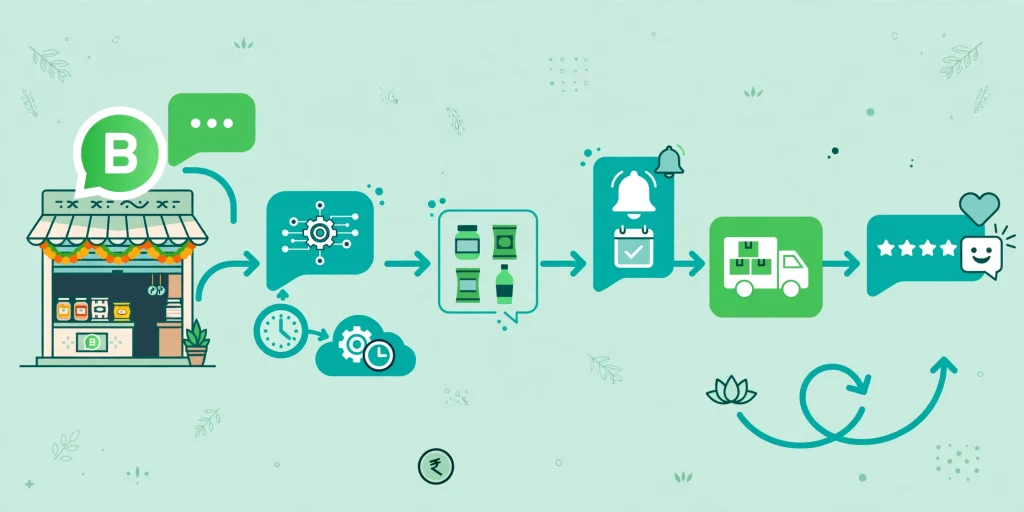
Trigger: A customer fills your website form, messages you on Instagram, or scans a QR code in your shop.
Step 1, instantly: An automatic welcome message goes out on the same channel. Keep it short: thank them, confirm what they asked about, and say when a human will reply. Example: “Thanks for reaching out. We have your enquiry about home cleaning, and our team will call you within 2 hours, between 10 am and 7 pm.”
Step 2, after 2 hours: If nobody on your team has replied yet, an automatic reminder goes to your team, not the customer.
Step 3, next morning: If the enquiry is still open, the customer gets one polite follow-up: “Hi, just checking in. Would you like us to share the price list and available slots for this week?”
Timing rules that work in India: Send business messages between 10 am and 8 pm. Avoid early mornings and late nights, because an 11 pm promotional message is how a business gets blocked.
Workflow 2: Abandoned Cart or Missed Call to Email Offer
This workflow recovers revenue you have already earned in attention but not yet in money.
Trigger: A customer adds products to your online cart and leaves without buying, or calls your business number and nobody answers.
Step 1, after 2 hours: Send a gentle reminder on email or WhatsApp: “You left something in your cart. It is still saved for you, and here is the link to complete your order.”
Step 2, after 24 hours: Send a small nudge with a reason to act now: “Your cart is still waiting. Order in the next 24 hours and we will add free delivery.”
Step 3, after 72 hours: Send a final message, then stop. “We have cleared your cart to keep your account tidy. If you still want these items, here is the link.”
For missed calls: A missed call triggers an instant SMS or WhatsApp: “Sorry we missed your call. What can we help you with? Reply here and we will call you back within 30 minutes.”
For more ideas on the content these workflows should carry, see our Content Marketing Strategy for Indian Small Businesses in 2026, which covers the messages, offers, and stories that make follow-ups worth opening.
WhatsApp Business API: Rules, Costs, and DPDP Act Basics
WhatsApp is where Indian customers actually are, so it deserves its own section.
WhatsApp Business app is the free app for a single phone. It has quick replies, labels, a catalogue, and away messages. It is manual, and it is right for most small businesses.
WhatsApp Business API is for automation at scale: automatic messages, chatbots, and integration with your CRM. You access it through an official provider, not by installing an app. You pay per message, usually about Rs 0.35 to Rs 0.80 depending on the category, so check your provider’s current rate card before you commit.
Opt-in rules. You may only send marketing messages to customers who have agreed to hear from you. Get that agreement clearly, at the point of enquiry, purchase, or sign-up, and keep a record of it.
Template approval. Marketing messages on the API must use pre-approved templates. Write them in plain language, submit them for approval, and do not change the wording afterwards without resubmitting.
DPDP Act consent basics. Under India’s Digital Personal Data Protection Act, you need consent to use a customer’s personal data, you should collect only what you need, and a customer can ask you to stop or delete their data.
Your 30-Day Measurement Plan to Prove ROI
Automation is only worth paying for if you can prove it works. This plan takes thirty days and four numbers.
Days 1 to 7, baseline. Before you change anything, write down four numbers: your average first-reply time, your follow-up rate (what share of enquiries get a second message), your enquiry-to-sale conversion rate, and your customer acquisition cost.
Days 8 to 21, build and run. Build Workflow 1 first, then Workflow 2. Do not change your offers during this period, because you want to measure the system, not a new discount.
Days 22 to 30, compare. Measure the same four numbers again. A healthy result looks like this: first-reply time falls from hours to minutes, follow-up rate rises from under half to over 80 percent, conversion improves by a few percentage points, and acquisition cost falls because you convert more of the enquiries you already paid to get.
The decision rule. If the system recovered even two or three sales in the month that would otherwise have been lost, it has paid for itself at the Rs 2,000 stack level. If you want to understand the paid traffic side, our guide to Performance Marketing for Indian Startups explains how acquisition cost and conversion work together.
FAQ
What is the best marketing automation tool for a small business in India?
There is no single best tool, only a best fit. Under 500 contacts, start with HubSpot free CRM and Brevo free email. With 500 to 2,000 contacts, Brevo Starter with Zoho CRM usually gives the best value.
How much does marketing automation cost in India?
A working setup costs Rs 0 on the free stack, about Rs 1,700 to Rs 2,000 a month on the mid stack, and about Rs 4,000 to Rs 5,000 a month on the advanced stack including WhatsApp message charges. All figures exclude GST, so add 18 percent.
Do I need the WhatsApp Business API, or is the free app enough?
The free WhatsApp Business app is enough for most small businesses with one person answering messages. You need the API only when you send hundreds of automated messages a month, need messages triggered by your CRM or store, or need more than one person answering from the same number.
Is marketing automation legal under the DPDP Act?
Yes, provided you follow the basics: get clear consent before sending marketing messages, collect only the data you need, store it securely in one system, honour stop and delete requests promptly, and never buy phone number or email lists.
How long before I see results from marketing automation?
You should see faster replies within the first week, because that is the first thing automation fixes. Better conversion usually shows within thirty days, once the follow-up sequences have run for a full cycle.
Conclusion
Marketing automation is not a luxury for large companies. It is a simple fix for the most common small business problem in India: enquiries that get a slow reply, follow-ups that never happen, and past customers who are never contacted again. Start with Workflow 1 this week.

2 Comments
Pingback: Telegram Marketing: A Complete 2026 Guide for Indian Businesses
Pingback: Google Ads vs Facebook Ads in India: Which Is Better in 2026?