

Introduction
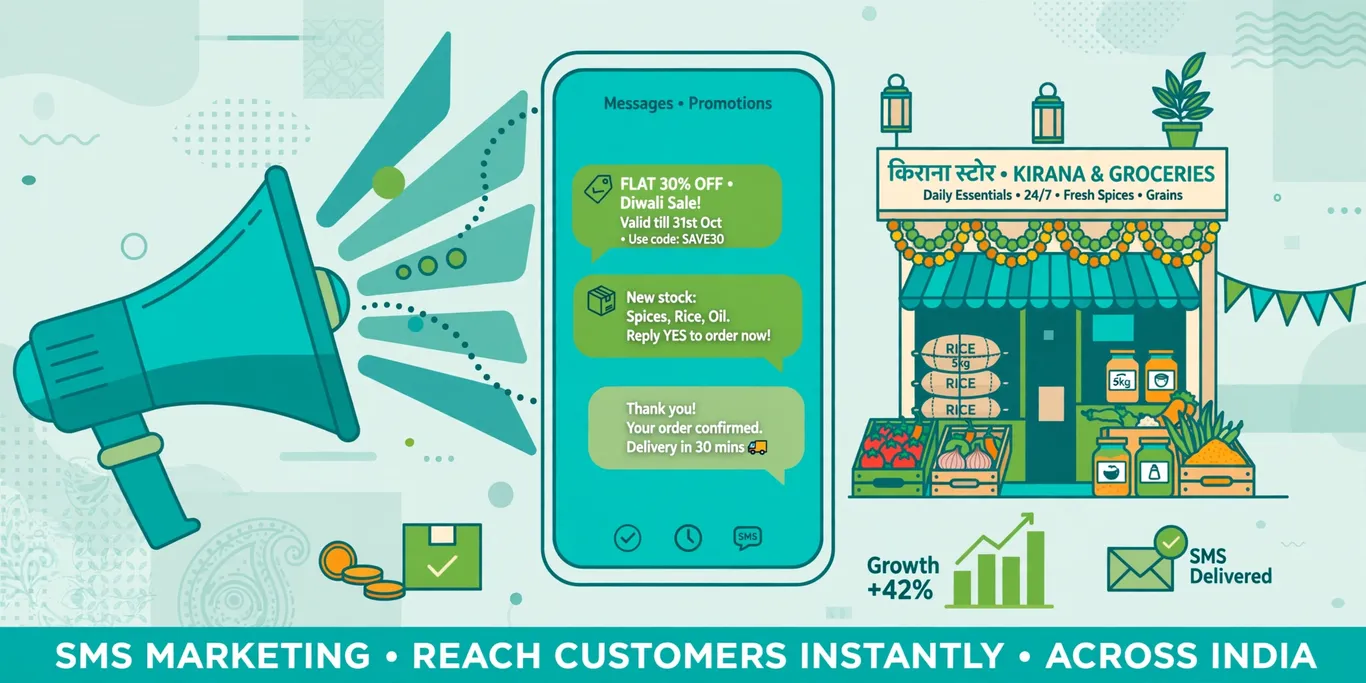
SMS marketing still works in India. Open rates routinely sit above 90 percent, and most messages are read within three minutes.
But the Telecom Regulatory Authority of India, known as TRAI, controls commercial messaging through the Distributed Ledger Technology platform, or DLT. Every business must register on DLT and get its sender headers and templates approved before sending.
How SMS Marketing Works in India
SMS marketing means sending promotional, transactional, or service messages to customers. A promotional SMS advertises an offer. A transactional SMS confirms an order, shares an OTP, or sends a delivery update. A service SMS reminds a customer about an appointment or a payment due date. TRAI treats these types differently.
Your business registers on a DLT platform run by an operator such as Jio, Airtel, Vodafone Idea, or BSNL. You register your entity, sender headers, and templates. When you send a campaign, your provider checks the message against the DLT records: if the header and template match, it goes to the customer, and if not, it is rejected. SMS needs no internet, no app, and no smartphone, so a customer with a basic feature phone receives your message just as reliably as one with a flagship phone in Mumbai.
DLT Registration: The Complete Checklist for 2026
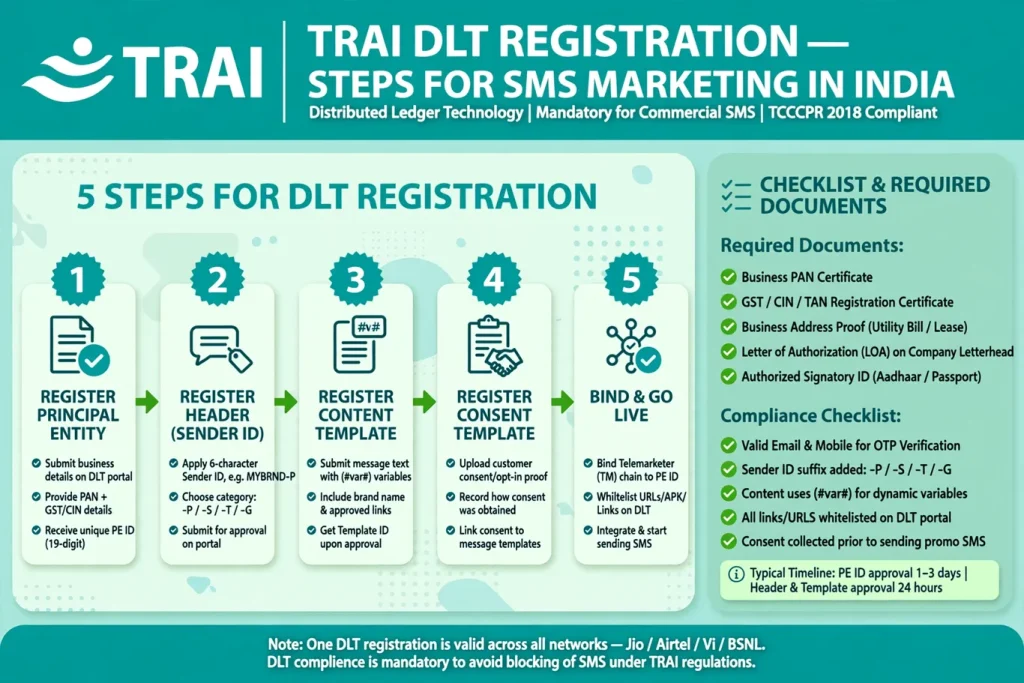
Here is the full DLT process, in order.
Step 1: Register your entity
Choose any operator DLT portal; registration on one is valid across operators. You will need a GST certificate or business proof such as Udyam registration, the PAN card of the business or proprietor, the Aadhaar card of the authorised signatory, and an authorisation letter on letterhead. The fee is typically Rs 5,000 plus GST, one time, and approval takes 2 to 5 working days.
Step 2: Register your sender headers
A header is the sender name customers see, such as VM-ABCDEF: six letters for your brand, prefixed by operator and message type codes. You can register up to 11 headers per entity, usually free or for a small fee, and approval takes 1 to 3 working days. Pick headers that match your brand name.
Step 3: Register your message templates
Every message must be registered as a template, with fixed text and clearly marked variables: placeholders for a name, amount, date, or order number, written as {#var#}. Register separate templates for promotional, transactional, and service messages. Approval takes 1 to 2 working days. Rejections usually happen because a variable sits in the wrong place, a URL is not whitelisted, or the wording belongs in a different category.
Step 4: Whitelist links and connect your provider
If your messages contain links, each domain must be whitelisted on the DLT portal. Public URL shorteners are generally not allowed. Once your entity, headers, and templates are approved, share your DLT entity ID with your provider, and you can start sending.
Rules to follow every day
- Promotional SMS can only be sent between 10 AM and 9 PM. Transactional and service messages are exempt.
- Promotional messages can only go to customers not on the Do Not Disturb list, unless they have explicitly consented.
- Every promotional message must offer a way to opt out, and you must honour opt-out requests promptly.
- Never send from an unregistered header or with an unapproved template.
What SMS Marketing Costs in India in 2026
Typical rates in 2026 sit between Rs 0.14 and Rs 0.25 per promotional SMS, depending on volume, route quality, and the provider. Transactional SMS usually costs more, often Rs 0.20 to Rs 0.35 per message.
Most providers sell SMS in prepaid packs. A pack of 10,000 promotional SMS might cost Rs 1,500 to Rs 2,500, while 1,00,000 SMS brings the per-unit price down towards Rs 0.14. Also budget for DLT registration at around Rs 5,000 plus GST, and a virtual number for replies at Rs 1,000 to Rs 3,000 per year. Skip short codes: they cost Rs 1,00,000 or more per year.
A realistic monthly budget for sending 10,000 to 20,000 SMS a month is Rs 2,000 to Rs 5,000. Before you fix your monthly numbers, read our guide on planning a digital marketing budget for a small business in India.
Top Bulk SMS Providers in India Compared
Price matters, but delivery rate, DLT support, and reporting matter more. A provider charging Rs 0.12 per SMS but delivering only 80 percent of messages is worse value than one charging Rs 0.18 with 95 percent delivery.
- MSG91: Promotional SMS from around Rs 0.15 per message. Strong DLT support, a clean dashboard, and good delivery reports. Best for reliable delivery and a self-serve dashboard.
- TextLocal: Promotional SMS from around Rs 0.18 per message. Dependable delivery and good customer support. Best for businesses that want phone support.
- Gupshup: SMS from around Rs 0.16 per message at volume, covering SMS, WhatsApp, and RCS in one place. Best for multi-channel messaging.
- Kaleyra: Pricing from around Rs 0.20 per message, with better rates at scale. Best for OTPs and transactional messages alongside promotions.
Before you commit to a large pack, ask for a delivery rate report and test with a small pack. Avoid any provider promising promotional SMS without DLT registration.
How to Build Your SMS List Legally
A good SMS list is small, honest, and engaged. A large list bought from a data seller produces complaints, blocks, and wasted money, and it breaks TRAI rules on consent.
- Ask at the point of sale. When a customer buys, ask for their mobile number and permission to send offers by SMS.
- Use a keyword opt-in. Print a keyword on your packaging, menu, or poster, such as “SMS OFFER to 56767”. Customers who text it have opted in.
- Never buy a database. Purchased lists contain people who never agreed to hear from you. Complaints can get your headers blocked, and conversions are close to zero.
- Clean the list regularly. Remove numbers that fail delivery and people who opted out. A list of 2,000 engaged customers beats 20,000 strangers every time.
Keep your consent records: if a customer complains to TRAI, you may need to prove they agreed to receive your messages.
SMS vs WhatsApp vs RCS: Which Channel Wins in 2026?
Indian small businesses in 2026 have three text channels to choose from.
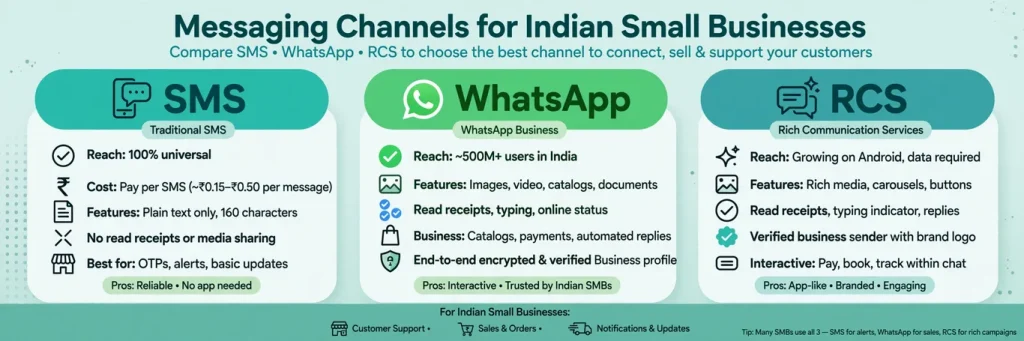
SMS reaches every phone, needs no internet, and costs Rs 0.14 to Rs 0.25 per message. It is limited to 160 characters per segment and cannot carry images or buttons. It is best for alerts, OTPs, reminders, and short offers.
WhatsApp reaches most Indian smartphone users and supports images, videos, buttons, and catalogues. But it needs template approval from Meta, costs more per conversation, and only reaches people who have WhatsApp installed and have opted in. It is best for rich product messages and follow-ups where a reply matters. Our guide to WhatsApp marketing for small businesses in India explains templates and costs in depth.
RCS, or Rich Communication Services, brings WhatsApp-like features, images, and buttons into the phone’s default messaging app. In 2026, adoption in India is growing fast on Android phones, but it does not yet reach iPhone and basic phone users the way SMS does. Costs sit between SMS and WhatsApp.
Use SMS and WhatsApp together: SMS for alerts, reminders, and short offers to your full list, and WhatsApp for rich messages and conversations with repeat customers. Test RCS for image-led promotions to Android users.
Ready-to-Use SMS Templates for Indian Small Businesses
Register each template on the DLT portal with your own brand name and variables before sending.
Retail: “Hi {#var#}, our Diwali Sale is live at {#var#}. Flat 30% off on all kurtis till Sunday. Visit us at {#var#} or shop online. T&C apply. To stop, reply STOP.”
Clinic: “Dear {#var#}, this is a reminder of your appointment with Dr {#var#} at {#var#} on {#var#} at {#var#}. Please arrive 10 minutes early. Call {#var#} to reschedule.”
Coaching class: “Hi {#var#}, admissions are open for Class 10 Science batch at {#var#}. Early bird fee Rs {#var#} till {#var#}. Call {#var#} to enrol.”
Restaurant: “Hi {#var#}, hungry? Get 20% off on all orders above Rs 499 at {#var#} today. Order here: {#var#}. Valid till 10 PM.”
Real estate: “Hi {#var#}, 2 BHK flats near {#var#} starting at Rs {#var#} are now available. Site visit this weekend. Call {#var#} to book.”
Keep templates short, specific, and honest.
Common TRAI Mistakes That Get Messages Blocked
Most blocked messages come from small errors that are easy to fix once you know them.
- Sending a promotional message as a transactional template. A discount offer is promotional, even for an existing customer. Register it as promotional and send it only between 10 AM and 9 PM.
- Changing approved template text. Adding a word or moving a variable breaks the match with the DLT record. Send the template exactly as approved.
- Using an unapproved link. Links must be whitelisted on the DLT portal, or the message will be rejected.
- Forgetting the opt-out instruction. Include “To stop, reply STOP” in promotional templates and honour every opt-out.
- Sending outside the allowed window. Promotional messages sent before 10 AM or after 9 PM are blocked automatically.
- Ignoring DND rules. Promotional messages to Do Not Disturb numbers will be blocked. Check that your provider scrubs DND numbers automatically.
When a template is rejected, read the reason on the DLT portal and fix the exact problem named.
How to Measure Results
Measure every campaign. Without numbers, you cannot tell which offers work.
- Delivery rate: The share of messages that reached the phone. A good campaign should deliver above 90 percent.
- Click-through rate: Track how many people clicked your link. A rate of 5 to 15 percent is strong for SMS in India.
- Conversion rate: The share of recipients who completed the action you wanted, such as a purchase or a booking. Use a unique coupon code per campaign so you can attribute sales accurately.
- Opt-out rate: The share of recipients who replied STOP. A rate above 1 percent means you are sending too often.
- Revenue per campaign: Multiply conversions by the average order value and subtract the campaign cost.
Test one thing at a time: the offer, the timing, or the call to action. SMS also works well alongside email. Our guide to email marketing for small businesses in India explains list building and automation.
Frequently Asked Questions
Is SMS marketing legal in India in 2026?
Yes, provided you follow TRAI rules: register on DLT, approve your headers and templates, send promotions only between 10 AM and 9 PM, and honour opt-outs.
How much does SMS marketing cost for a small business?
Most small businesses spend Rs 2,000 to Rs 5,000 per month for 10,000 to 20,000 SMS. Rates in 2026 are typically Rs 0.14 to Rs 0.25 per promotional SMS and Rs 0.20 to Rs 0.35 per transactional SMS.
What is DLT registration, and is it compulsory?
DLT registration is compulsory for every business that sends bulk SMS in India. DLT is the system TRAI uses to verify commercial messages.
Is SMS better than WhatsApp for small businesses?
Neither is better in every situation. SMS wins on reach and cost, because it works on every phone without internet or an app. WhatsApp wins on richness, with images, videos, and buttons. Most successful Indian small businesses use both.
Conclusion
SMS marketing in India in 2026 rewards businesses that respect the rules and their customers. DLT registration takes about a week and a modest fee, but it protects your messages from being blocked.
SMS is not the newest channel, and it is not the flashiest. But for an Indian small business that wants a direct, affordable, and measurable way to reach customers, it remains one of the most reliable tools available.
