

Introduction
Most Indian business blogs have the same problem. They attract readers, sometimes thousands of them, and then quietly lose them. A visitor reads a useful article, closes the tab, and never returns. The business gets traffic, but no enquiries, no phone calls and no sales pipeline.
A blog becomes a lead generation machine only when every article has a job beyond informing the reader. That job is to move a specific reader one step closer to a conversation: a download, a WhatsApp message, a consultation booking, or a quote request. This guide shows how to build that system for an Indian business, step by step, without aggressive pop-ups or misleading promises.
The approach here is different from generic lead generation lists. Those lists talk about ads, directories and cold calling. This guide is about the blog itself: how to choose topics that attract buyers, how to place offers inside articles, and how to follow up in the ways Indian buyers actually respond to, especially WhatsApp and phone calls.
Why Most Business Blogs Do Not Generate Leads
A blog fails as a lead tool for a few predictable reasons. First, the topics attract the wrong audience. An article about a broad industry trend may rank well but bring students, job seekers or competitors, not buyers. Second, the article ends with nothing to do. There is no next step, no offer, and no reason to share contact details. Third, the business treats the blog as a publishing chore rather than a sales asset, so no one checks which posts produce enquiries.
Fixing these problems does not require more traffic. In many cases, a blog with 2,000 well-targeted monthly readers will produce more enquiries than a blog with 20,000 casual readers. The difference is intent. A reader searching for a price, a comparison, a provider near them, or a solution to an urgent problem is far closer to buying than a reader browsing general advice.
Before writing your next post, ask one question: what should a reader do after finishing this article, and why would they want to do it? If you cannot answer that in one sentence, the article is not ready to be a lead asset yet.
Step 1: Choose Topics That Attract Buyers, Not Just Readers
Lead generation starts with topic selection. Divide your topics into three groups.
Buyer-intent topics are closest to a sale. Examples include comparisons, pricing guides, provider shortlists, and “how to choose” articles. A reader searching for these terms is already evaluating options. These posts should carry your strongest offers, such as a free consultation or a quote form.
Problem-aware topics come next. The reader knows they have a problem but has not chosen a solution. How-to guides, checklists and mistake-avoidance articles fit here. These readers need education first, so offer a useful download or a checklist in exchange for their details.
Awareness topics build reach and trust but rarely convert directly. Industry news, opinion pieces and broad explainers belong here. They are still valuable, because they bring new readers into your audience, but do not judge them by immediate enquiries.
A healthy Indian business blog needs all three, but a lead-focused blog should publish at least half its posts in the first two groups. If every post is an awareness piece, the blog will look busy and produce nothing.
For a broader system around this, read our guide on how to grow a blog in India in 2026.
Step 2: Build One Clear Funnel Per Article
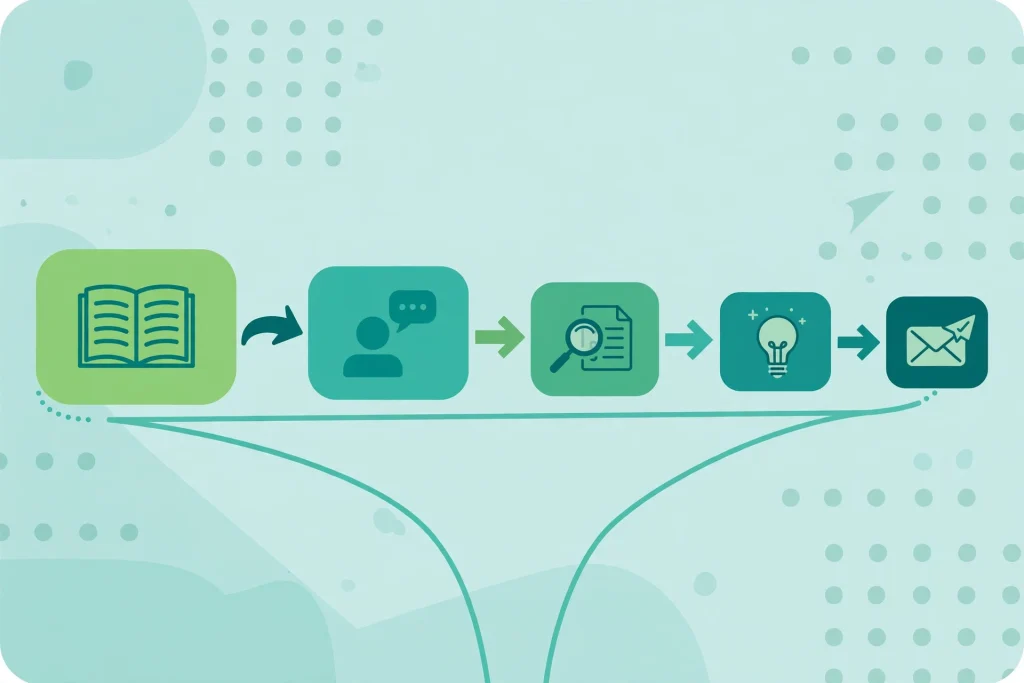
A funnel is simply the path from reading to enquiry. Keep it short. Indian buyers, especially on mobile, will not follow a five-step maze.
A practical blog funnel has four stages:
- Attract: the article answers a specific search query completely and honestly.
- Offer: inside the article, the reader is offered something useful and directly related, such as a checklist, template, price calculator or free audit.
- Capture: the reader shares a name and either an email address or a WhatsApp number to receive it. Keep the form to two or three fields.
- Follow up: the business responds quickly, on the channel the reader chose, with something helpful rather than a hard sales pitch.
Every article should have one primary offer, not three competing ones. If a post about website costs offers a pricing checklist, a newsletter signup and a webinar invitation at the same time, most readers will choose none of them. Pick the offer that matches the article topic and repeat it in a natural place, usually after the introduction and again near the conclusion.
Step 3: Create Lead Magnets Indian Buyers Actually Want
A lead magnet is a free resource offered in exchange for contact details. The best ones solve a small, specific problem immediately. Generic ebooks with titles like “The Ultimate Guide to Success” rarely convert, because the reader cannot tell what they will get.
Lead magnets that work well for Indian service businesses include:
- A one-page checklist, such as a pre-launch website checklist or a GST filing checklist.
- A template, such as a quotation format, a content calendar, or a social media caption bank.
- A price or cost guide with realistic Indian price ranges, not vague “it depends” answers.
- A comparison sheet that helps the reader choose between two or three common options.
- A short audit or scorecard, where the reader answers ten questions and receives a personalised result.
Make the lead magnet genuinely useful even if the reader never buys from you. That generosity builds trust, and trust is what turns a download into a conversation later. Deliver it instantly, by email or WhatsApp, and mention the delivery method on the form so the reader knows what to expect.
Step 4: Place Offers Where Readers Actually See Them
Placement matters as much as the offer itself. Most readers never reach the bottom of a long article, so an offer that appears only in the final paragraph is almost invisible.
Use three placements, and keep them calm rather than intrusive:
- After the introduction, add a short, relevant call to action in a paragraph or a simple box.
- In the middle of the article, after a section that proves your expertise, add a second mention tied to that section.
- Near the conclusion, add the main call to action with a clear benefit and a single button or form link.
Avoid exit pop-ups that block the whole screen on mobile, and avoid forms that ask for a full address, company turnover or budget before the reader has received any value. In India, a WhatsApp button or a short form with name, phone number and one question converts far better than a long corporate form.
Step 5: Follow Up Fast, On WhatsApp and By Phone
Speed is the biggest advantage a small Indian business has over a large competitor. A lead that waits 48 hours for a reply has usually contacted someone else by then. Aim to respond within one business hour, and within a few hours at most.
WhatsApp is often the best first channel, because that is where many Indian buyers already talk to businesses. Send a short, personal message: thank them for downloading the resource, ask one relevant question, and offer a specific next step, such as a 15-minute call. Do not send a long brochure as the first message.
A simple follow-up sequence works well:
- Day 0: deliver the resource and send a short WhatsApp message.
- Day 2: share one extra tip related to the resource, and ask if they have a question.
- Day 5: offer a free consultation, audit or quote, with a clear time limit for booking.
- Day 10: send a relevant case study or example, then stop if there is no reply.
Track every lead in a simple sheet or a basic CRM. Record the source article, the offer, the date, and the outcome. Without this record, you cannot tell which posts deserve more promotion and which topics should be retired. For help measuring what a blog actually returns, see our guide on how to measure blog ROI.
Step 6: Turn Readers Into a Repeat Audience
Not every reader is ready to buy today. Some will buy in three months, after reading several articles. A blog lead system must therefore keep in touch without being annoying.
The simplest retention tool is an email list, but in India a WhatsApp broadcast list or a small community group can work even better for some niches, provided readers have opted in and messages stay useful. Send one genuinely helpful update per week, not daily promotions. Each update should link back to a useful article, not only to a sales page.
Repurpose your best articles too. A strong blog post can become a short video, a carousel, a checklist download, or a newsletter issue. This multiplies the return on one piece of work and keeps your brand in front of readers who prefer different formats. Our guide on content marketing in India explains how to turn readers into customers across formats.
Also, review your older posts every quarter. Update prices, add a new offer, fix broken links, and improve the call to action. An old post that already ranks is often the cheapest source of new leads, because the traffic is already there.
A 30-Day Plan to Launch Your Blog Lead System
Week 1: Audit your top ten posts by traffic. For each one, note the reader intent, the current call to action, and whether it produced any enquiry. Remove or rewrite weak calls to action.
Week 2: Create two lead magnets that match your two highest-intent posts. Build short forms with name and WhatsApp number only, and test them on mobile.
Week 3: Add the three placements described above to your top five posts, and set up a simple follow-up sequence with templates your team can actually use.
Week 4: Publish two new buyer-intent posts with offers built in from the start, and review the first month of leads by source article. Double down on the topic and offer that produced the best enquiries, not just the most downloads.
Common Mistakes to Avoid
Do not buy email or phone lists and add them to your blog funnel. Those contacts did not ask to hear from you, and the complaints and spam reports will damage your domain and your brand.
Do not promise a free resource and then deliver a sales brochure. Readers notice immediately, and they will not trust the next offer.
Do not judge a lead magnet only by downloads. A checklist downloaded by 500 students is worth less than a consultation booked by 20 business owners. Track enquiries and sales, not vanity metrics.
Do not hide your contact details. A blog that generates interest but has no visible phone number, WhatsApp button or contact page is leaking leads every day.
Frequently Asked Questions
How many leads can a small business blog generate?
It depends on traffic quality, topic intent and follow-up speed. A small blog with 2,000 to 5,000 targeted monthly readers and a good offer can reasonably expect a steady trickle of enquiries each month, while a high-traffic general blog may produce far fewer. Track enquiries per post rather than comparing yourself to large publishers.
Do I need paid ads to generate leads from a blog?
No. Organic search, social sharing and email or WhatsApp follow-up can produce leads without ads. Paid promotion can speed up a proven post, but it should amplify a funnel that already converts, not rescue one that does not.
Is WhatsApp allowed for business follow-up in India?
Yes, provided the person has shared their number with you or opted in, and you respect opt-outs. Use WhatsApp Business, keep messages relevant and personal, and never add numbers from purchased lists.
What is the best lead magnet for a service business?
The best lead magnet solves one immediate problem for your ideal buyer: a checklist, a template, a realistic price guide, or a short audit. Test two options on your highest-traffic post and keep the one that produces more qualified enquiries, not just more downloads.
How long does it take for a blog lead system to work?
Expect early signals within four to six weeks if you already have traffic, and a reliable pipeline within three to six months of consistent publishing and follow-up. New blogs need longer, because search traffic itself takes time to build.
Conclusion
A blog generates leads when it is built as a system, not as a collection of disconnected articles. Choose buyer-intent topics, give each article one clear offer, capture details with a short form, and follow up fast on the channel the buyer prefers.
Start with your best existing posts. Add one strong offer to each, set up a simple follow-up sequence, and measure enquiries by article. That small, disciplined system will do more for your business than publishing twice as many articles with no next step at all.
